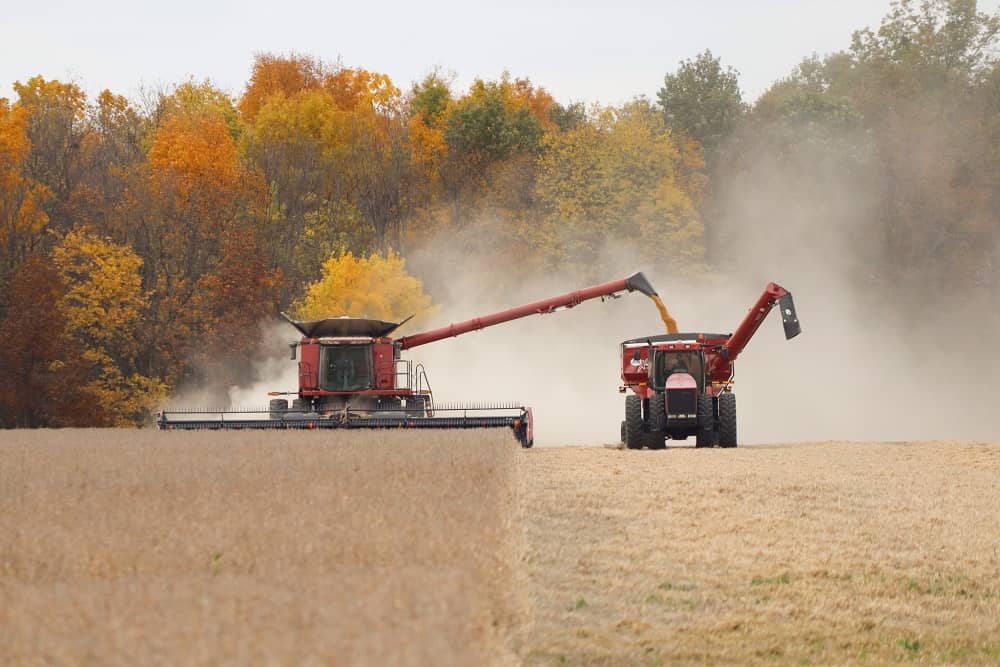
An ideal stretch of late-October weather has given Hoosier farmers a prime window to roll combines across the state, pushing harvest pace past five-year historical averages while wheat seeding continued at a rapid clip.
According to the USDA Crop Progress Report released Oct. 26, 2026, Indiana producers capitalized on nearly a full week of clear skies—logging 6.8 days suitable for fieldwork during the week ending Oct. 25.
That extended dry run allowed combine operators to clear 15% of the state’s total corn acreage and 16% of the soybean crop in just seven days, making up lost ground and pulling ahead of typical autumn progress.
Indiana Harvest Accelerates Past Averages
Hoosier corn harvest reached 61% complete as of Oct. 25, stepping up from 46% the previous week and moving ahead of the 2021–2025 five-year average of 59%.
Despite a dry finish to the late growing season, grain quality and crop conditions remained solid across the state. Indiana corn condition rated 64% good-to-excellent (56% good, 8% excellent), with 28% in fair condition and just 8% rated poor or very poor.
Soybean harvest made swift headway as well, advancing to 75% complete statewide compared to 59% the prior week. That puts Indiana growers 3 percentage points ahead of their 72% five-year average.
The clear weather also favored winter wheat planting and emergence. Indiana growers had 67% of the state’s intended winter wheat crop in the ground by Oct. 25, edging past the 65% five-year average. Wheat emergence advanced to 27%, up from 14% the previous week, though still slightly trailing the five-year average pace of 33%.
Subsoil and topsoil moisture levels held steady across the state. Topsoil moisture in Indiana was rated 56% adequate and 2% surplus, with 42% short to very short (31% short, 11% very short). Subsoil moisture followed a similar trend, holding at 56% adequate and 2% surplus, with 42% short to very short (29% short, 13% very short).
Indiana pasture and range conditions reflected the season’s late-summer dry spell, with 52% rated good-to-excellent (48% good, 4% excellent), 34% fair, and 14% poor or very poor.
National Progress Lags Historical Paces
Across the country, a surge in open weather allowed producers nationwide to make significant field progress, though overall corn harvest and wheat emergence continue to trail historical norms.
Across the 18 primary corn-producing states, harvest reached 60% complete as of Oct. 25, climbing 16 percentage points from 44% the previous week. However, national corn harvest progress remains behind the 66% five-year average. The national corn condition held steady from the previous week, with 56% rated good-to-excellent (43% good, 13% excellent), 26% fair, and 18% poor or very poor.
U.S. soybean harvest surged to 79% complete nationwide, up from 64% the week prior. That performance places national bean harvest slightly ahead of the 77% five-year average pace.
Winter wheat planting reached 76% across the 18 major producing states, nearly matching the five-year average of 77%. National wheat emergence advanced to 53%, just 1 percentage point behind the 54% five-year average.
Nationally, topsoil moisture levels across 48 states were rated 57% adequate and 5% surplus, with 38% short to very short (26% short, 12% very short). Subsoil moisture stood at 54% adequate and 3% surplus, with 43% falling into short to very short categories (28% short, 15% very short).
U.S. pasture and range conditions remained constrained in several regions, with only 23% rated good-to-excellent (19% good, 4% excellent), 33% fair, and 44% poor or very poor (26% poor, 18% very poor).
(Note: Due to a lapse in federal funding in late 2025, USDA NASS estimates for the corresponding prior-year week of 2025 were canceled. Five-year average benchmark comparisons reflect 2021–2025 published and imputed data.)