A partnership forged 75 years ago between Purdue University and a Brazilian agricultural university is continuing to shape the future of agricultural research, education and innovation — connecting generations of students and faculty across international borders.
What began in 1951, when Purdue faculty members traveled more than 4,000 miles from West Lafayette, Indiana, to the Federal University of Viçosa (UFV) in Brazil, has grown into a decades-long collaboration that helped establish graduate education programs, strengthen agricultural research and transform the institutions on both sides of the partnership.
Now, as Purdue and UFV celebrate the 75th anniversary of their partnership and UFV marks its 100th anniversary, university leaders are looking to build on that foundation to address mounting challenges facing global agriculture, including food security, environmental sustainability and agricultural resilience.
The milestone was commemorated in August, when a Purdue delegation traveled to Brazil to honor the partnership’s history and explore opportunities for future collaboration.
“This anniversary reminds us that the strongest international partnerships are built over time and through sustained interaction,” said Gerald Shively, Purdue Agriculture associate dean and director of International Programs in Agriculture.
“For 75 years, Purdue and Viçosa have created opportunities for students and faculty to learn from one another, advance agricultural research and form relationships that extend far beyond either campus. We are proud of that history and excited to build on it as we address the challenges facing agriculture today and in the future.”
A Partnership That Helped Transform Agricultural Education
The roots of the Purdue-Viçosa partnership stretch back to a pivotal period in UFV’s development.
Beginning in 1951, Purdue faculty and staff members worked alongside Brazilian colleagues to strengthen agricultural education and research at an institution that would grow from a rural vocational school into one of South America’s leading agricultural universities.
Over the next two decades, more than 90 Purdue faculty and staff members taught courses, helped establish graduate programs and worked to build the academic infrastructure needed to advance agricultural research in Brazil.
The exchange extended in both directions, with UFV faculty members traveling to Purdue for advanced education and professional training.
Among the Purdue faculty members who contributed to the partnership were Ellsworth Christmas, a former professor of agronomy; Jules Janick, professor emeritus of horticulture; Doug Knudson, a former professor of forestry; and D. Woods Thomas, who became Purdue Agriculture’s first associate dean for international programs.
Their contributions helped establish a foundation for agricultural education and research that generations of students and faculty have continued to expand.
For Purdue Agriculture, the relationship also became a launching point for broader international engagement.
Robert L. “Bob” Thompson, former dean of Purdue Agriculture and professor of agricultural economics, experienced that impact firsthand.
“My professional career began in Viçosa during the final two years of my PhD program in 1972 and 1973,” Thompson said.
“I was there not only to conduct my doctoral research but also to work alongside colleagues in UFV’s Department of Rural Economy. Together, we strengthened academic programs, shared knowledge and built relationships that helped carry the Purdue-Viçosa partnership forward.”
Thompson later helped expand international opportunities for Purdue Agriculture students during his tenure as dean from 1987 to 1993.
When he became dean, relatively few Purdue Agriculture students studied abroad. By the time he left the position, 10% of the college’s graduates had completed a significant international experience.
That commitment to global education has continued to grow.
During the 2025-26 academic year, 27% of Purdue Agriculture undergraduate students participated in at least one study abroad experience, reflecting the college’s emphasis on preparing future agricultural leaders to operate in an increasingly interconnected world.
Preparing the Next Generation of Agricultural Leaders
For today’s agricultural students, the Purdue-Viçosa partnership offers opportunities to move beyond textbooks and classrooms to experience firsthand how agriculture operates in different environments.
Purdue students have completed research placements at UFV in agricultural engineering, agronomy, animal sciences, biosystems engineering, food processing engineering, food science and veterinary medicine.
Those experiences allow students to earn academic credit while working alongside Brazilian researchers and gaining practical exposure to agricultural production systems and research methods.
But the lessons extend well beyond the laboratory.
Students have explored research involving coffee and macaúba palms, met Brazilian agricultural producers and developed relationships with UFV students. They have made cheese alongside dairy farmers, participated in martial arts and dance, and learned how coffee growers are improving soil health while producing high-quality crops.
The experiences offer an important lesson for future agricultural professionals: Scientific knowledge alone is not enough to solve the world’s agricultural challenges.
Understanding local culture, environmental conditions and farming practices is equally important.
“Experiencing how different regions tackle agricultural challenges teaches students that technical knowledge must always be paired with local cultural and environmental context,” said Heidi Arola, Purdue assistant vice president of Global Programs and senior international officer.
“International partnerships, such as the very impactful and historic one with UFV, provide students with a combination of classroom and hands-on experience. By collaborating across diverse teams, they gain critical thinking skills essential for today’s global workforce.”
For an agricultural industry increasingly connected through international markets, research networks and shared environmental challenges, those skills are becoming an important component of preparing graduates for careers in agriculture and related industries.
Turning International Connections Into Agricultural Research
The partnership is also creating new opportunities for Purdue and Brazilian researchers to collaborate on issues affecting agricultural producers around the world.
In early 2026, Purdue Agriculture’s International Research Academy brought early-career faculty members to UFV and three other Brazilian universities to identify potential research partners and explore collaborative projects.
The Purdue delegation included faculty members specializing in animal sciences, agronomy, food science, and agricultural and biological engineering.
Their research interests span some of agriculture’s most pressing challenges, including food security, environmental sustainability and agricultural resilience.
The academy was designed to help researchers move beyond initial introductions and identify specific areas where their expertise could complement the work of international colleagues.
By bringing together scientists and educators from different agricultural systems, Purdue and UFV are creating opportunities to develop research approaches informed by different environments, production practices and areas of expertise.
For farmers, the long-term implications could extend to new knowledge and technologies addressing challenges that cross national boundaries.
The effort also demonstrates how a partnership established decades ago can continue to generate opportunities for new generations of researchers.
Celebrating 75 Years — And Looking Ahead
The anniversary celebration brought Purdue representatives together with UFV leaders, faculty, alumni and international partners to recognize the institutions’ shared history and discuss the future of their collaboration.
Representing Purdue during the August visit were Shively, Arola and Thompson.
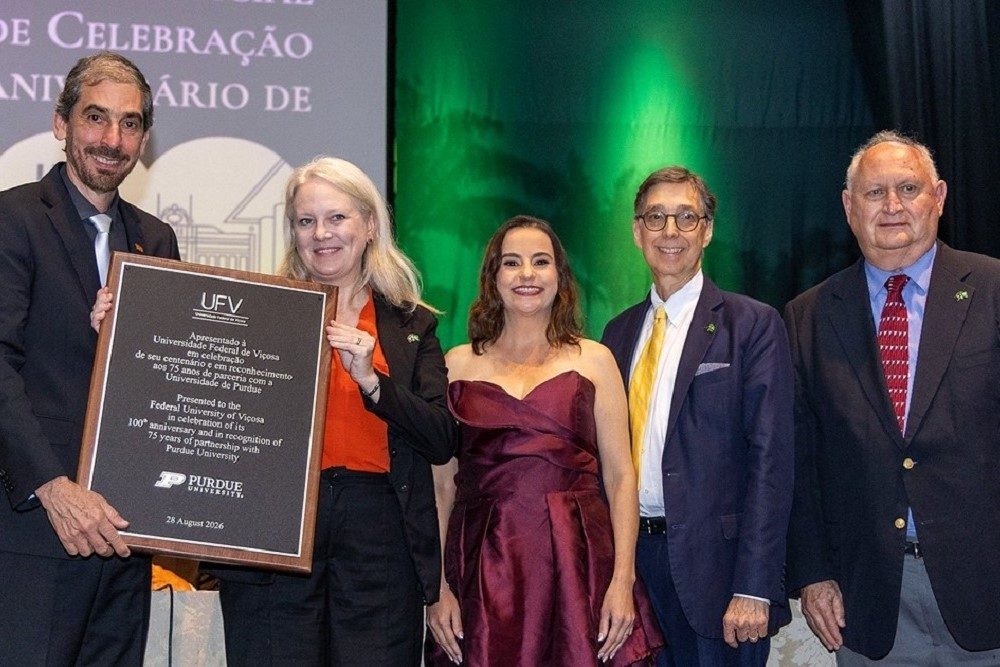
At a formal plenary session on Aug. 28, UFV Rector Demetrius David da Silva and Vice Rector Rejane Nascentes recognized the Purdue delegation before approximately 700 guests, including university and government leaders.
The Purdue delegation presented da Silva with a custom-designed bronze plaque commemorating the 75-year partnership. Purdue professor Jeffrey Volenec contributed to the tribute by crafting the plaque’s mounting board from Indiana walnut — a tangible connection between the two agricultural institutions separated by thousands of miles.
For UFV, the partnership represents far more than an anniversary milestone.
Raul Narciso Guedes, UFV professor and dean of research and graduate studies, said Purdue’s contributions during the Brazilian university’s formative years continue to influence its academic programs, research capabilities and international reputation.
“For many at UFV, the Purdue-Viçosa partnership represents more than a chapter in our shared history,” Guedes said.
“The knowledge, collaboration and generosity Purdue faculty brought during UFV’s formative years helped lay a foundation that continues to shape our university’s development and international standing.”
As global agriculture faces mounting pressure to produce food sustainably, strengthen agricultural resilience and meet the needs of a growing world, Purdue and UFV are positioning their longstanding relationship to help address those challenges.
The partnership that began with a journey from Indiana to Brazil in 1951 has evolved into a continuing exchange of research, education and agricultural expertise.
And 75 years later, both universities are looking to ensure that the next generation of agricultural innovation is built on the same principle that launched their relationship: bringing people together across borders to advance agriculture for the future.