
For decades, farmers have been asked to fill out USDA surveys, answer questions from enumerators and provide information that helps shape the crop and livestock statistics driving markets and farm policy. Now, the U.S. Department of Agriculture says it wants to change the way that information is collected.
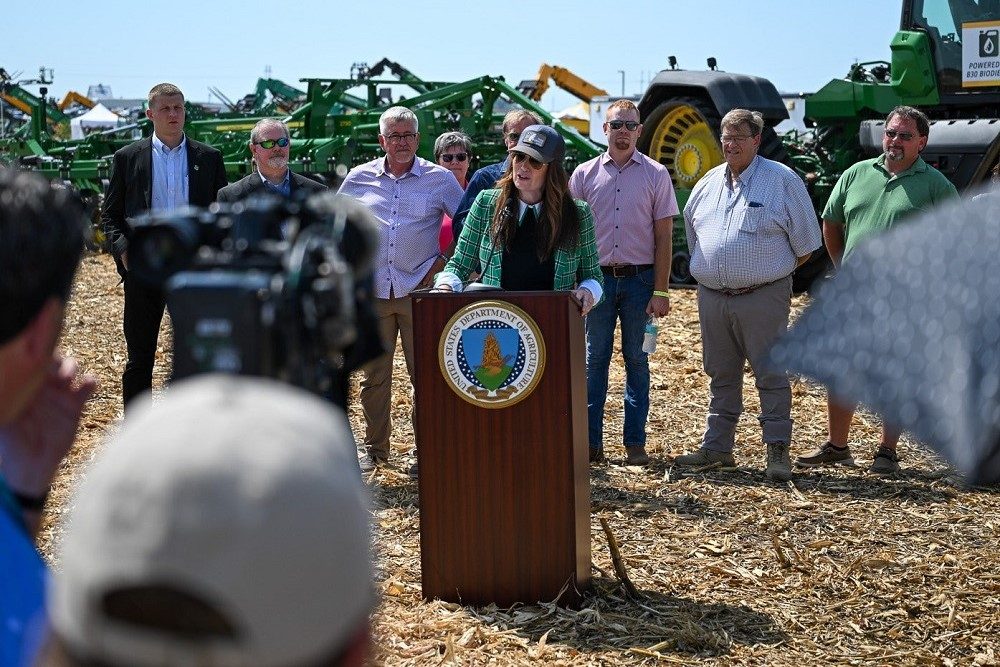
USDA Secretary Brooke Rollins announced Tuesday at the Farm Progress Show in Boone, Iowa, the department’s new USDA Data Modernization Plan, a broad effort designed to reduce the reporting burden on producers while improving the timeliness, accuracy and usefulness of the agricultural data they depend on.
The plan comes as USDA acknowledges a problem that has been building for years: Producer participation in federal surveys has been declining, in part because many farmers view the reporting process as burdensome.
That decline matters.
USDA statistics are used to produce crop and livestock estimates, support risk-management programs, guide disaster assistance and inform some of the biggest business and policy decisions in agriculture.
“America’s farmers and ranchers are the backbone of our food and agricultural system, and USDA should respect their time while delivering the reliable information they need,” Rollins said. “This plan puts Farmers First by cutting burdensome red tape, using modern tools, and ensuring producers have a stronger voice in how USDA collects and reports agricultural data.”
The department’s challenge is to modernize that process without sacrificing the credibility of the statistics farmers, traders, agribusinesses and policymakers have relied on for generations.
USDA was created in 1862, and collecting and disseminating agricultural information was one of its original missions. But the technology available to USDA — and the technology available to farmers — looks dramatically different than it did more than 160 years ago.
The new plan attempts to close that gap.
Fewer duplicate questions
One of the most immediate changes USDA is pursuing is greater use of information producers have already provided to another USDA agency.
The plan calls for USDA to make better use of administrative data from agencies including the Farm Service Agency, Risk Management Agency and Natural Resources Conservation Service so the National Agricultural Statistics Service does not have to ask producers for the same information again.
USDA also plans to explore more pre-filled survey fields using administrative data and previously reported information.
For farmers accustomed to answering similar questions for multiple USDA programs, that could mean less time spent reporting basic information.
The department also plans to review its highest-burden surveys, identify repeated questions and redundant contacts, and establish burden-reduction targets for priority programs.
USDA says it will report progress on those efforts annually.
The department is also looking at a more mobile-friendly reporting experience, including shorter question sequences, simplified navigation and the potential use of a mobile application and text-message communications when privacy and statistical requirements can be met.
Satellites could play a bigger role
Perhaps the most consequential changes could come in how USDA estimates acreage and yields.
The department plans to conduct a structured pilot testing whether administrative records, geospatial observations and modern crop modeling can provide a stronger foundation for acreage and yield estimates while maintaining essential producer-reported information.
That could mean a greater role for satellite imagery, precision-agriculture technology, geospatial analysis and other remotely sensed information in USDA’s statistical system.
USDA already uses satellite imagery and its Cropland Data Layer as part of its agricultural monitoring efforts. The department notes that the Cropland Data Layer recently increased in resolution from 30 meters to 10 meters, improving the quality of the geospatial information available for agricultural analysis.
The modernization plan calls for continued expansion of geospatial applications for acreage estimation, crop monitoring, yield analysis and disaster assessment.
USDA also plans to work with NASA and land-grant universities on remote sensing, soil moisture, crop-yield modeling and other research.
The goal is not necessarily to eliminate farmers from the data-collection process.
Instead, USDA says technology should complement producer knowledge and reduce the amount of information farmers have to provide manually.
The department will also assess whether optional producer-supplied information — including photographs, geolocation-assisted information or other observations — could be used to improve yield estimates.
Any such efforts, USDA says, would be subject to privacy, confidentiality, security and statistical-accuracy safeguards.
USDA embraces AI and machine learning
The modernization plan also puts artificial intelligence and machine learning squarely into USDA’s future data strategy.
USDA plans to evaluate responsible uses of AI and machine learning for workflow automation, data integration, anomaly detection and geospatial analysis.
The department also plans to develop cloud-based data pipelines and shared analytical environments that allow agencies to make better use of information already collected elsewhere within USDA.
That is intended to address another long-standing problem: USDA’s information systems have developed independently over decades and are not always well integrated.
USDA says better integration could allow information already reported by producers to move more efficiently between agencies, reducing duplication while making data available more quickly.
The department also plans to continue developing AgStatBot, a conversational tool intended to help users find and interpret published NASS data.
Another planned tool, AgInsights, is expected to provide an interactive platform for accessing USDA data through charts, maps and other visualizations.
Trust may be the biggest challenge
While technology is at the center of the modernization effort, USDA recognizes that better technology alone will not solve the problem.
The department’s plan repeatedly emphasizes trust and transparency.
USDA says it will continue protecting producer privacy and confidentiality under applicable legal and statistical safeguards, including the Confidential Information Protection and Statistical Efficiency Act.
It also plans to provide producers with clearer explanations of why information is being requested, how it is used, how farmers are selected for surveys and what reports are generated from their responses.
That effort could become increasingly important as USDA expands its use of administrative data, artificial intelligence, satellite imagery and other technologies.
“USDA’s agricultural statistics are only as strong as the trust and voluntary participation of America’s producers,” said Scott Hutchins, USDA under secretary for Research, Education, and Economics. “By combining producer knowledge with sound science and modern technology, USDA can reduce the reporting burden while improving the quality of the information farmers and policymakers rely on.”
USDA plans to continue holding listening sessions, commodity discussions and roundtables with producers and agricultural organizations.
The department also plans to establish a quarterly Survey Chat to give producers another opportunity to ask questions and provide feedback about the data-collection process.
And beginning with the 2024 and 2025 crop seasons, NASS plans to develop retrospective Crop Season in Review reports comparing estimates and forecasts made throughout the season with final estimates and explaining the data sources used.
That increased transparency could be critical as USDA experiments with new methods of collecting and analyzing information.
Balancing technology with farmer knowledge
Kip Tom, USDA’s special adviser for Data Modernization, said the goal is to bring together technology, producer knowledge and the various data systems already operating across the department.
“While American agriculture and USDA look vastly different than they did in 1862, the need for timely, accurate, and useful agricultural statistics remains constant,” Tom said.
The modernization plan is, in many ways, an attempt to address two problems at once.
USDA wants farmers to spend less time filling out surveys. At the same time, it needs enough reliable information to maintain the statistical foundation that agriculture, government and financial markets depend upon.
Those goals are closely connected.
If producers increasingly view USDA surveys as time-consuming or redundant, participation can fall. If participation falls too far, the quality and confidence in the resulting statistics can suffer.
USDA says modernization can help break that cycle — replacing some traditional data collection with technology and information already available to the government while preserving the producer input that makes agricultural statistics valuable.
“This plan brings USDA agencies together, breaks down outdated information silos, and applies modern technology to provide producers and rural communities with better service,” Tom said.
USDA says implementation begins immediately, with additional pilots, evaluations and technology improvements expected in the months and years ahead.
For farmers, the ultimate test will be simple: less time answering questions, more confidence in the numbers that come back.
And for USDA, the challenge may be even bigger — modernizing a data system built over more than 160 years without losing the trust and statistical credibility that made those numbers matter in the first place.
To learn more, please view the full USDA Data Modernization Plan.