For Indiana farmers, resilience is not an abstract concept. It is built into every planting decision made around a wet spring, every crop harvested through a dry summer and every calculation made when markets, weather and input costs refuse to cooperate.
Half a world away, farmers face an entirely different set of challenges — but many of the questions are remarkably familiar.
How do you grow food when the environment works against you? How do you make the most of limited resources? And how do you build agricultural systems capable of adapting when conditions change?
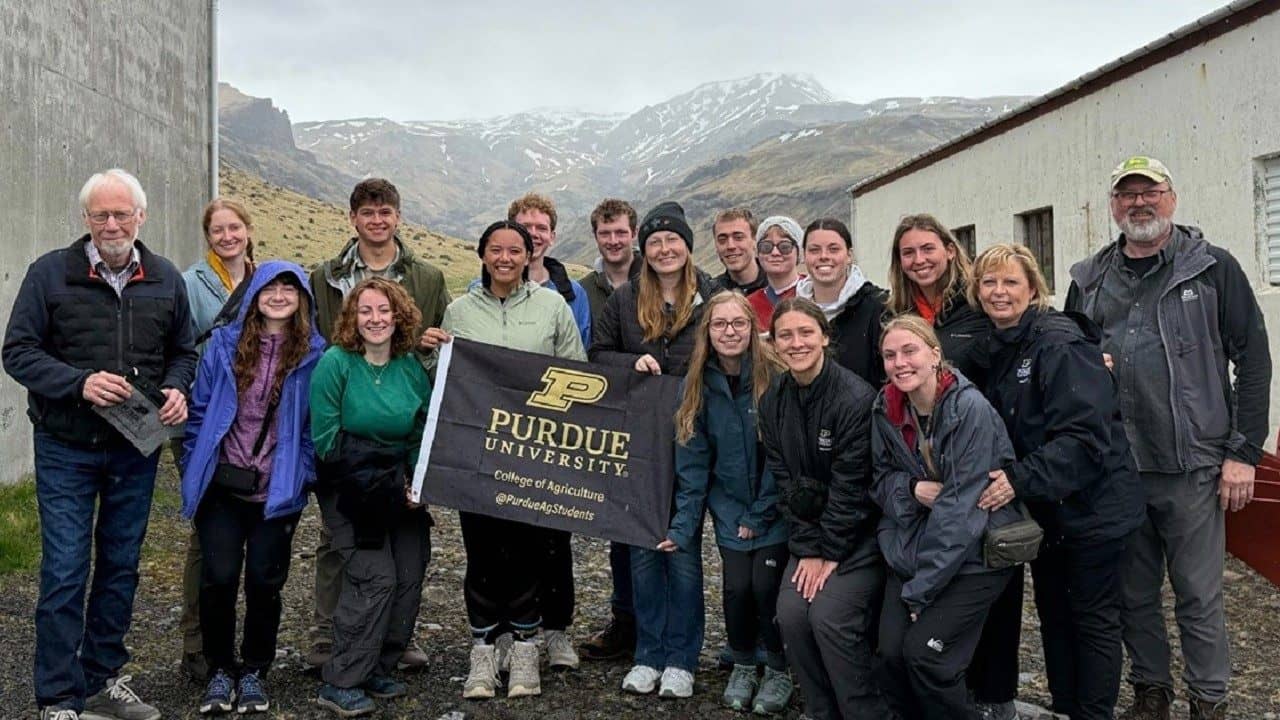
Those questions were at the heart of Purdue Agriculture’s first Iceland: Food, Farming and Sustainable Futures study abroad program, a 10-day journey in May 2026 that put 14 Purdue students in the middle of one of the world’s most challenging agricultural landscapes.
The program was developed and led by Christie Shee, clinical assistant professor of natural resources and environmental science, and Christine Wilson, senior associate dean and director of academic programs.
For Shee, the trip represented much more than simply taking students overseas.
“Studying abroad and immersing yourself in another culture is transformational and invaluable. I want to be a mentor for that experience,” said Shee.
And Iceland, with its volcanoes, glaciers, geothermal energy, cold temperatures and long winter darkness, provided an unusually powerful classroom.
Where the Environment Writes the Rules
Iceland’s agricultural landscape can seem almost otherworldly to someone accustomed to the broad, fertile fields of Indiana.
There are no endless expanses of Midwestern corn and soybean fields. Instead, agriculture exists within a landscape shaped by volcanic activity, rugged terrain, retreating glaciers and a climate that can make growing food a formidable challenge.
Yet Icelandic producers have learned to work with those limitations rather than simply fight against them.
That lesson came into sharp focus at Friðheimar Greenhouses, where students saw tomatoes growing year-round despite an environment that offers little natural sunlight during parts of the year.
Geothermal energy provides heat, while artificial lighting helps create the growing conditions the crops need.
“It’s amazing how they sustainably grow tomatoes and other vegetables year-round in a climate where it’s cold and dark for many months of the year,” Shee said.
Friðheimar has also expanded beyond production into dining, specialty food products and tourism — creating additional value from the same agricultural operation.
For an Indiana farm audience, the lesson may be bigger than geothermal greenhouses.
The most resilient agricultural systems often begin by recognizing what resources are available — and then figuring out how to turn those resources into an advantage.
That could mean geothermal energy in Iceland. In Indiana, it might mean fertile soils, abundant water, livestock manure, renewable energy, local markets, processing capacity or new technologies.
“What I find most compelling is the innovation, the focus on sustainability and the resilience that comes from living and farming in a challenging climate,” Shee said.
A Different Kind of Farm Country
The students’ education extended well beyond greenhouses.
Throughout the 10-day program, they examined how volcanic activity affects communities and farmland, explored land reclamation and glacial change, and studied Iceland’s fisheries, aquaculture and emerging blue economy.
They met farmers, researchers and educators and saw firsthand how geology, geography, culture and available resources influence the way communities produce food and manage natural resources.
The goal wasn’t simply to show students what Iceland does.
It was to make them ask why.
Why did a particular agricultural system develop in that location? Why are certain resources used in one way rather than another? How do communities respond when environmental conditions impose limits? And which ideas could potentially translate to other places?
Those are questions that matter in Indiana, too.
Farmers here are increasingly being asked to produce more while dealing with tighter margins, extreme weather, changing regulations, resource concerns and growing pressure to demonstrate how agriculture can remain productive and sustainable for generations.
Iceland doesn’t provide Indiana with a blueprint.
But it does provide a reminder that agriculture has always been an exercise in adaptation.
Seeing Sustainability Differently
For Aaliyah Carlisle, a senior from central Indiana studying natural resources and environmental science with concentrations in environmental quality and restoration and soil and water sciences, Iceland helped turn concepts from the classroom into something tangible.
“During my time in Iceland, it was amazing to see how people use the resources available to them,” said Carlisle.
One example came from Iceland’s fishing industry, where students learned about efforts to use as much of each fish as possible.
Carlisle said the experience demonstrated how sustainability can become more than a theory when economic and environmental realities demand creative solutions.
She even encountered fish collagen in an energy drink — an experience that provided an unexpected connection between sustainability, food production and everyday life.
For a college student who admits to thriving on caffeine while learning about sustainability, the lesson apparently came with a little humor, too.
But beneath that experience was a serious point: innovation frequently emerges when people refuse to waste what they already have.
That principle resonates on an Indiana farm, where efficiency has long been central to surviving and succeeding.
Every bushel matters. Every acre matters. Every gallon of fuel, pound of fertilizer and drop of water matters.
Lessons That Travel Home
For Wilson, the greatest value of the program was not necessarily a particular farming practice the students could bring back from Iceland.
It was the perspective they gained by seeing familiar agricultural and environmental questions through an entirely different lens.
“Study abroad gives students an opportunity to apply what they are learning at Purdue while examining agricultural and environmental challenges from a different perspective.”
That perspective, Wilson said, can build confidence, curiosity and the ability to work with people whose experiences and approaches are different.
Those qualities could prove increasingly important for the next generation of Indiana agriculture.
The challenges facing farmers rarely fit neatly into one discipline. Soil health intersects with economics. Climate intersects with production. Technology intersects with labor. Water intersects with environmental stewardship. And agricultural policy can ripple across all of them.
Preparing future agricultural leaders therefore requires more than teaching them how a particular system works.
It requires teaching them how to think when the system changes.
A Lesson for Indiana Agriculture
Iceland’s landscapes may look dramatically different from the fields stretching across Indiana, but the fundamental agricultural challenge is surprisingly familiar.
Farmers everywhere must take the resources they have, understand the environment around them and find ways to remain productive when conditions change.
Indiana farmers don’t need volcanoes or glaciers to understand resilience. They see it every year.
They see it when a planting window opens after weeks of rain. They see it when a drought threatens a crop. They see it when input prices surge or a market suddenly disappears. They see it when a farm family finds a new way to add value, conserve resources or keep the operation moving into another generation.
The Purdue students who traveled to Iceland came home with a broader view of those challenges — and a reminder that some of agriculture’s most important lessons can come from places that look nothing like home.
In Iceland, the landscape can be harsh, cold and unforgiving.
Yet food is still produced.
Communities endure.
Resources are stretched.
Innovation takes root.
And agriculture adapts.
For Indiana’s next generation of farmers and agricultural leaders, perhaps that is the most valuable lesson of all: resilience isn’t about having perfect conditions. It’s about learning how to thrive with the conditions you’ve been given.