
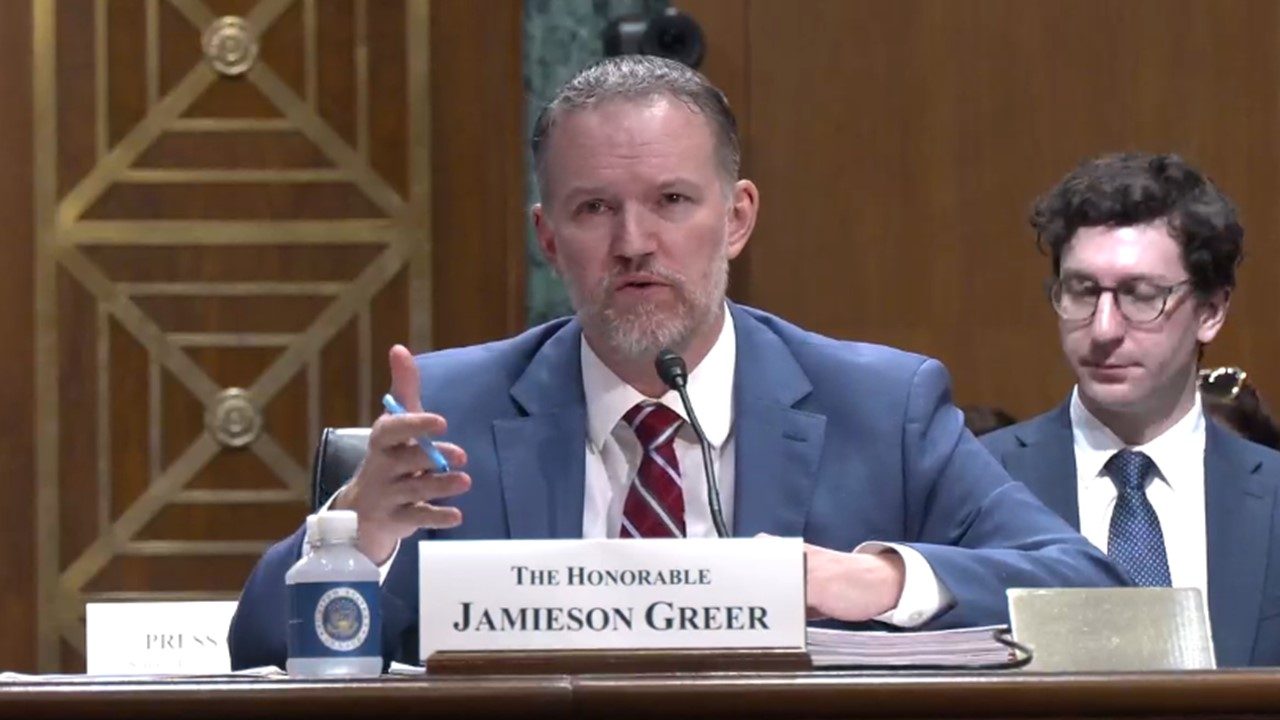
Testifying before the Senate Finance Committee, U.S. Trade Representative Jamieson Greer pushed back against congressional critics this week, defending the Trump administration’s aggressive use of tariffs and trade agreements as a necessary economic reset. For the Midwest agricultural sector, Greer delivered an optimistic progress report, asserting that the administration’s trade agenda is successfully reopening foreign markets and steering the country back toward an agricultural trade surplus.
Addressing lawmakers on Capitol Hill, Greer pointed to the macro-economic conditions inherited from the previous administration, noting that sweeping trade imbalances had left key domestic industries vulnerable.
“As you know, the president’s trade policy in 2025 was characterized by a national emergency, a 1.2 trillion dollar trade deficit… and an industrial base too atrophied to support our national security and economic competitiveness adequately, let alone support a strong middle class,” Greer told the committee. “That national emergency still persists, and so our policy remains the same.”
Focus on Farm Trade Numbers
While critics during the hearing raised concerns regarding input costs, retaliatory risks, and the financial pressures facing crop and livestock producers, Greer emphasized that the agricultural ledger tells a distinctly positive story.
According to the trade representative, new reciprocal trade frameworks and aggressive enforcement have reversed years of declining export access.
“For agricultural trade specifically, the story is even better,” Greer testified. “President Biden left office with a monthly agricultural trade deficit of 6.2 billion. Under President Trump, it’s under 3 billion, and we are on the road to an agricultural trade surplus again.”
Greer argued that the strategy of leveraging tariffs alongside bilateral negotiations is designed to build a more resilient domestic economy that protects producers from foreign market shocks and secures reliable long-term food security.
“Fundamentally, all of these initiatives and the trade policy overall aim to answer the question of what should our economy look like?” Greer said. “For President Trump and his administration, the answer is clear: We want an economy that is resilient from shocks… with an increased level of manufacturing, certainty of food security, and a robust services sector.”
Diverging Views from Farm Country
Despite the administration’s upbeat data on shrinking deficits and new market access commitments—such as recent pacts spanning multiple continents—the debate on Capitol Hill underscored a lingering divide. Farm-state lawmakers and industry analysts continue to balance the administration’s trade optimism against day-to-day realities in the field, including tight profit margins, elevated input expenses, and the heavy reliance on federal program supports.
As the administration presses forward with its trade framework through 2026, the ongoing friction between macro-level trade balancing and grassroots farm economics remains a central narrative for agricultural producers across the Midwest.
CLICK BELOW for Hoosier Ag Today’s radio news report: