Facing a severe agricultural crisis triggered by escalating warfare in the Middle East, the Trump administration on Wednesday unveiled a $500 million emergency grant initiative designed to rapidly expand domestic fertilizer production and rescue American farmers squeezing under the weight of skyrocketing input costs.
The initiative, dubbed the Fertilizer Investment & Expansion for Long-Term Domestic Supply (FIELDS) program, marks a aggressive pivot away from the conservation and climate-centered agricultural policies of the previous administration. Funded through the USDA’s Commodity Credit Corporation (CCC), the program will distribute grants ranging from $15 million to $100 million to fast-track “shovel-ready” manufacturing plants for critical crop nutrients like nitrogen, phosphate, and potash.
The rollout arrives at a perilous moment for the American agricultural economy. The outbreak of the U.S.- and Israel-led war with Iran has choked off more than 30 percent of global fertilizer exports due to Iran’s near-total blockade of the Strait of Hormuz. According to federal data, U.S. fertilizer imports from affected Middle Eastern ports plummeted to zero in May, sending shockwaves through the domestic supply chain just as spring planting concluded.
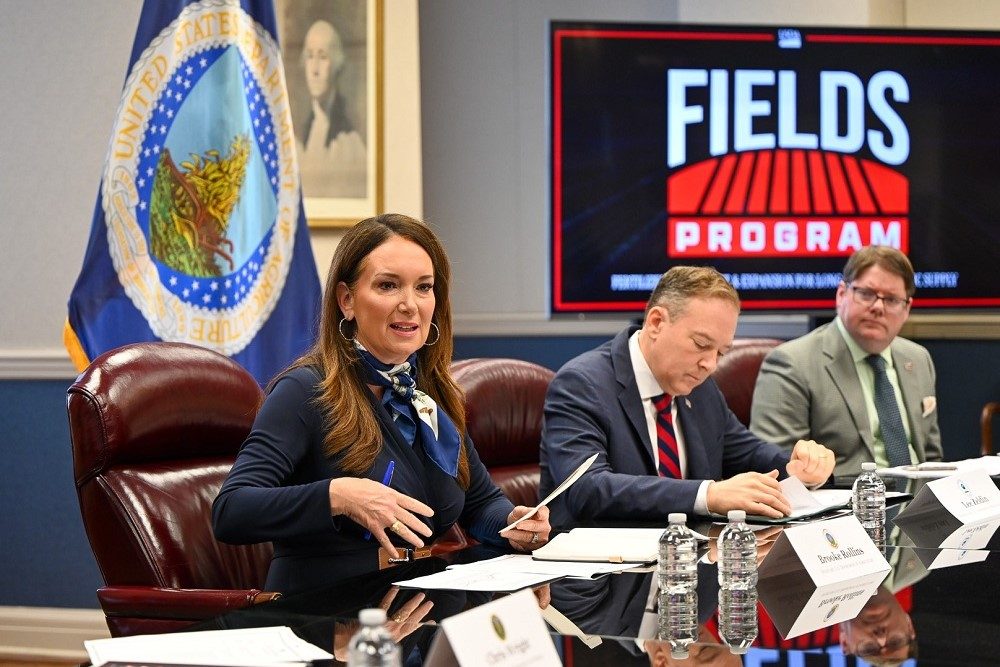
“For decades, American farmers were forced to rely on unstable foreign suppliers for one of the most important inputs needed to feed our nation,” Agriculture Secretary Brooke L. Rollins said during a press conference flanked by agricultural sector executives. “Today we are announcing a plan to end this consolidation and bring competition back to the American fertilizer industry. Farm security is national security.”
A Sharp Ideological Shift
The FIELDS program represents an explicit repudiation of the Biden administration’s $900 million Fertilizer Production Expansion Program (FPEP). According to Rollins, a internal USDA review of 121 projects inherited from the previous administration revealed that only eight had actually been completed.
Rollins sharply mocked the criteria used by past officials, claiming the funds had been diverted away from heavy industrial production toward fringe green initiatives.
“There were several in there looking at worm worms and flower pots and kombucha—lots of climate language craziness. We are obviously pulling all of that back,” Rollins said. “The previous administration chose to prioritize their radical climate agenda… and as a result let this problem exacerbate by not getting shovels in the ground and only building 6 percent of their stated goal.”
Instead, the new program relies on an interagency “energy dominance” strategy. Environmental Protection Agency Administrator Lee Zeldin pledged that the EPA would fast-track regulatory reviews for developers with existing private capital who are ready to build immediately. Energy Secretary Chris Wright similarly tied the initiative to the administration’s wider anti-regulation, pro-hydrocarbon agenda, arguing that past energy policies had artificially inflated food prices.
Market Squeeze and Antitrust Probes
The federal capital injection comes as a relief to independent producers, though industry leaders note that building chemical infrastructure requires immense upfront liquidity. Joshua Westling, CEO of J. Westling & Co., which is currently developing a $1.2 billion nitrogen complex in Gothenburg, Neb., noted that federal matching dollars are crucial for domestic survival.
“The hardest part isn’t the engineering, it’s the upfront capital,” Westling said.
Yet, the administration’s emphasis on free-market competition faces structural hurdles. The American fertilizer sector is heavily consolidated—a dynamic the USDA is attempting to bypass by explicitly barring the market’s four largest dominant players from applying for FIELDS grants.
Furthermore, federal officials admitted Wednesday that domestic price hikes may not be entirely driven by geopolitical scarcity. Under questioning, Deputy Agriculture Secretary Stephen Vaden disclosed that the Department of Justice and the Federal Trade Commission have launched sweeping civil and criminal investigations into potential price-gouging and corporate collusion.
“Both the Department of Justice and the Federal Trade Commission are investigating both civilly and criminally the fertilizer market,” Vaden said. “What they’re looking at there is… has there been collusion in determining where fertilizer goes, not just here domestically but overseas.”
Program Details & Eligibility
The USDA has opened the application portal via Grants.gov, with a strict submission deadline of August 15, 2026.
Key Stipulation: To prevent further market consolidation, eligible applicants—including corporate affiliates—must not hold a market share greater than or equal to the entity that holds the fourth-largest share of the domestic market for nitrogen, sulfur, phosphate, or potash.
| Feature | Program Parameters |
| Total Funding | At least $500 million via the CCC Charter Act |
| Award Range | $15 million minimum / $100 million maximum |
| Eligible Entities | Independent for-profit corporations, cooperatives, Tribes, and local governments |
| Primary Allowed Uses | Facility construction, land acquisition, equipment modernization, and logistical infrastructure |
The multi-pronged strategy to stabilize input prices also includes the temporary waiver of the Jones Act to ease maritime shipping constraints, the addition of potash to the federal Critical Minerals list, and the suspension of countervailing import duties on Moroccan phosphate.
Whether these interventions can outpace the inflationary pressures of an active Middle Eastern war remains the defining question for the American farm belt heading into the autumn harvest.

