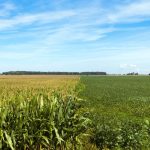
Indiana’s corn and soybean crops have taken a weather roller coaster ride this growing season, but agronomists say statewide yield potential remains very much alive…although it now depends on what happens during the rest of July.
Early-season flooding, ponding, and repeated heavy rains reduced stands in some fields, especially across central and eastern Indiana.
According to Corn Specialist, Dan Quinn, “I do think a lot of areas probably lost at minimum 10 to 15%. When you look at where the plants are at, the size of them, the recovery level of them, I do think the younger plants are probably losing a lot more yield than the later planted stuff that recovered a lot better or just tolerated the flooding a lot better. But I do think a minimum of 10 to 15%. But we have a lot of areas where the ponding was significant and we have wide swath areas that the plant didn’t survive at all. So you can look at what is the area of that field that didn’t have any survival. So areas that if we see significant flooding for seven plus days, we might have 40, 50, 60% yield loss in areas. A lot of areas in the state, especially if you split the state in half and took the whole west side of the state, had yield loss and a lot of areas that will recover some, but not to the full potential if we didn’t have these conditions.”
Other areas have benefited from abundant moisture, setting up the possibility for above-average yields where root systems remained healthy.
Meanwhile, in the soybean fields, Soybean Specialist Shaun Castell says, “There’s some good rules of thumb. You can think about some of those, let’s say V4 saturated conditions, waterlogged a bushel or so, an acre a day kind of thing. Beyond probably beyond the first three days. Once it’s been saturated that far, we have oxygen depletion occurring. Now we have the roots that are compromised. I say v4-v5, those middle to late vegetative stages going to be bushel to bushel and a half on some of those for each day after that.”
Both Agronomists say the next two to three weeks of weather will be critical in determining whether Indiana produces an average crop or one that exceeds expectations.
Check out the latest Crop Chat Podcast here:

