
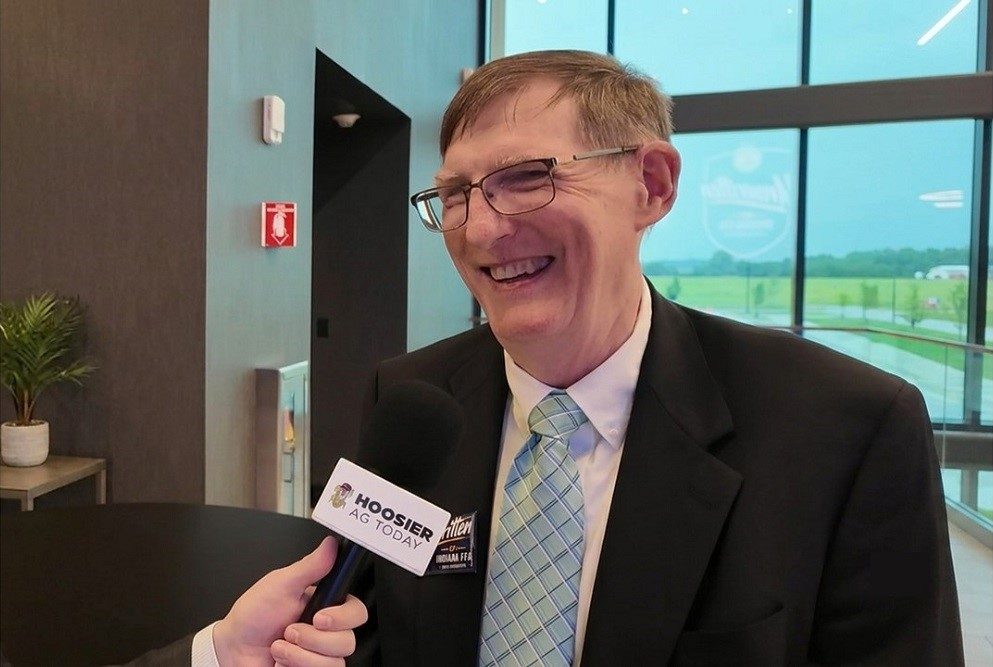
Behind nearly every agriculture classroom and FFA chapter in Indiana, there’s a good chance you’ll find the influence of Dr. Allen Talbert. The retiring Purdue professor was recently honored for a career spent mentoring the next generation of ag educators.
Talbert, a professor of agricultural education who is retiring from Purdue University on July 1 after a 32-year career, stands a towering 6 feet 7 inches tall. But at the Riverview Health Arena in Noblesville this week, his physical stature was entirely eclipsed by his professional footprint.
On Wednesday, June 17, Talbert was awarded the prestigious 2026 VIP Award during the 97th Indiana FFA State Convention—an honor reserved for individuals who have devoted their entire lives to exceptional service to Indiana agriculture and education.
For Talbert, walking through the convention lobby is a slow-moving gauntlet of high-fives, emotional reunions, and impromptu selfie requests from the very people running high school agricultural programs across the Midwest.
“Walk about three feet, talk. Walk three feet, talk,” Talbert said with a laugh, pausing just after a former student stopped him for a photograph. “Well, you saw the young man that wanted to take a selfie with me. I taught him several years ago.”
He isn’t exaggerating the numbers. Talbert estimates that over his three decades at Purdue, he has personally taught or mentored as many as 80 percent of Indiana’s current agriculture teachers and FFA advisors.
“It is difficult to state the immense impact Allen has had on Agricultural Education in Indiana and beyond,” said Sarah E. LaRose, an associate professor of Agricultural Education at Purdue. “Since he has taught at Purdue since 1994, he has taught the vast majority of Indiana’s some 371 agriculture teachers and been a constant steady presence of leadership for the profession.”
The Multiplication of Impact
Talbert’s journey into agricultural education began in Buckingham County, Virginia, where a middle school agriculture teacher made a profound impression on him. After graduating from Virginia Tech and teaching high school for six years, he earned his PhD from Texas A&M before arriving at Purdue in August 1994.
Over the next 32 years, he co-authored Foundations of Agricultural Education, a textbook widely used in teacher preparation programs across the United States, and dedicated his research to recruiting and retaining underrepresented minority groups in agriculture.
But his primary canvas was the classroom.
“Well, that’s the multiplication,” Talbert said, reflecting on his career. “That one ag teacher impacts a hundred students a year, and then over the course of a career, they impact thousands of students. And so to know that the seed that you’ve planted, when you come here tonight, that’s pretty special. Yeah, makes me feel real good. And being recognized makes me just honored.”
The landscape Talbert’s students are entering has fundamentally transformed since he first walked onto Purdue’s campus.
“When I first arrived, we were using chalkboards—maybe whiteboards,” Talbert recalled. “And now we use all sorts of technology to do presentations. Our ag teachers have gone from maybe one computer in the classroom to every student has a device.”
The shift isn’t just logistical; it is deeply technological. High school students in rural Indiana are no longer just learning livestock evaluation and crop rotation; they are studying autonomous tractors, precision fertilizer applications, drones, and the ethical integration of artificial intelligence in farming.
“We work with our student teachers on how to use AI properly with their students and how to teach their students to use it properly,” Talbert said. “And there are classes in the high school for them to learn those technologies and then apply them when they take jobs.”
As the technology has grown, so has the demand. During Talbert’s tenure, the number of agriculture educators in Indiana nearly doubled. “We’ve gone from about 200 ag teachers in the state to almost 400 ag teachers in the state,” he noted.
‘Quiet Leadership’
Behind the statistics and the textbook credits, colleagues say Talbert’s true legacy lies in his mentorship.
“Allen has been the ideal mentor and colleague,” LaRose said, recalling her arrival at Purdue as a young assistant professor straight out of graduate school. “Right away, Allen asked for my insight and expertise on important programmatic decisions for ag education. He validated and encouraged me to form into my own best self as a faculty member, not simply a replica of his vision.”
Phillip J. VanFossen, the Suzi & Edward Gallagher Dean of Education at Purdue, praised Talbert’s “quiet leadership” and his exhaustive, less visible work on the university’s Teacher Education Council. “This work is less visible than journal articles or teaching awards, but is nonetheless invaluable to the teacher education mission,” VanFossen said.
When pressed to name a student who exemplifies the reach of his work, Talbert points directly to the leadership of the very organization honoring him this week.
“Tammy Ketchin was one of my students, and she’s now the executive director of Indiana FFA,” Talbert said, noting that Ketchin was the one who insisted he endure the spotlight of the convention. “I was hesitant to do it, and she said, ‘No, no, no, you have to do that because of all the ag teachers in the audience that want to recognize you.’”
What Comes Next
Though his official retirement is just days away, Talbert will retain a presence at the university as Professor Emeritus. When asked what the new title means to him, he offered a classic, dryly witty response: “Means that I can do anything I want to but I won’t get paid for it.”
He plans to remain in West Lafayette, tackling an accumulation of home projects, relaxing, and traveling to visit family. But he won’t be entirely absent from the agricultural community. Talbert intends to continue volunteering as a judge for the Indiana FFA and advocating for the recruitment of the next generation of educators.
“If you know a young person that’s interested in teaching others and making an impact on the next generation, have them contact Purdue,” Talbert said.
For a man who spent 32 years cultivating the teachers who feed the Midwest, the work, it seems, is never truly finished.