
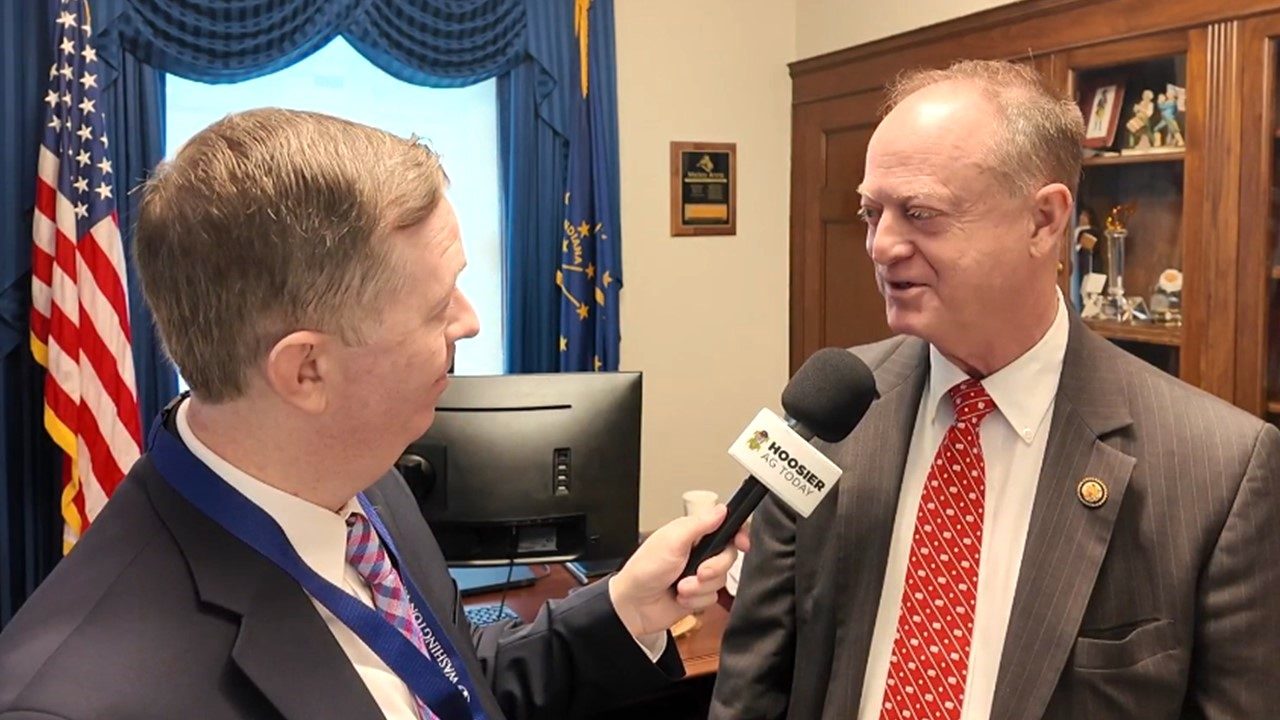
As Congress turns from passing a long-delayed farm bill to the next major policy fight, Republican lawmakers are signaling that overhauling the nation’s agricultural workforce system will be a top priority—an issue that has long frustrated farmers who depend on foreign workers to sustain their operations.
“The H2-A visa program is very clumsy, very hard to comply with, and really encourages people not to follow the law,” said Congressman Mark Messmer, an Indiana Republican who sits on the House Agriculture Committee.
The current H-2A visa program, created to allow U.S. farms to hire temporary foreign workers, has for years drawn criticism from agricultural groups for its complexity, cost and rigid structure. Farmers must navigate an intricate application process involving multiple federal agencies, meet strict housing and transportation requirements, and adhere to wage rules that can shift significantly from year to year. For many producers—particularly smaller operations—the compliance burden can be prohibitive, even as labor shortages intensify across rural America.
Messmer’s 8th Congressional District in southwestern Indiana reflects those pressures. The region’s farms—ranging from turkey and dairy operations to specialty crop producers growing watermelons and pumpkins—depend heavily on immigrant labor. Yet the H-2A program is largely designed for seasonal work, limiting visas to short-term durations that do not align with the year-round needs of livestock producers.
“If you’re a livestock operator, you need year-round labor, not just seasonal labor,” said Messmer. “Now the folks who grow melons and produce in my district—which is a huge part of my district—they need the seasonal workers, but you know, the dairy operators, the turkeys, the chickens. If you’re in livestock operation, you need year-round help and the H2-A visa program is not really fit to deliver that. So, we do need to revise it, we need to streamline it, we need to make it easier to get the workers that the farmers need, because you just can’t get American citizens to do that kind of work. And if the migrant workers are willing to do it, it’s key to get that done.”
At the center of the debate is the Adverse Effect Wage Rate, or AEWR, a federally mandated minimum wage that H-2A employers must pay. The rate is intended to ensure that hiring foreign workers does not undercut domestic wages, but agricultural leaders have argued that the formula—historically based on federal surveys of farm labor pay—has produced sharp and uneven increases, particularly in states where data is limited.
Those disparities have had tangible consequences in border regions, where producers compete for labor across state lines. Messmer said Indiana farmers were at a disadvantage when AEWR calculations placed their required wages significantly higher than those in neighboring states.
“[The Department of Labor] sets the wage rate off surveys. Indiana was about the only state complying with the survey responses, and so their Adverse Effect Wage Rate was $4 an hour higher than Kentucky. Well, that pushed a lot of that farm labor across the border and negatively impacted farmers in my district,” says Messmer.
In recent years, farm groups including the American Farm Bureau Federation (AFBF), the National Association of State Departments of Agriculture (NASDA) and the National Council of Farmer Cooperatives (NCFC) have pushed for reforms to both the visa system and the wage formula, arguing that rising labor costs—combined with inflation in fuel, fertilizer and equipment—are squeezing already thin margins. They have also warned that without changes, more producers may scale back operations or shift production overseas.
Messmer credited changes made late last year by the U.S. Department of Labor, in coordination with the U.S. Department of Agriculture, with easing some of those pressures in Indiana by moving away from the previous survey-based approach.
“I worked with the Department of Labor and USDA when I got in office last year, and they got rid of the survey process. It netted out a $6 an hour drop for farm labor in Indiana, which is a huge win—a 35% reduction in their cost of operation,” Messmer says.
Even so, broader concerns remain unresolved. Agricultural employers continue to argue that the H-2A program’s seasonal limitations leave critical gaps for year-round sectors like dairy and poultry, while worker advocates maintain that wage protections and oversight are essential to prevent exploitation.
House Agriculture Committee Chairman Glenn “GT” Thompson said lawmakers are preparing to release draft language for a comprehensive agricultural labor reform bill, which would be followed by a public comment period of several weeks. The legislation is expected to fall under the jurisdiction of Jim Jordan and the House Judiciary Committee, setting up what could become one of the most consequential—and contentious—policy debates for the farm economy in the months ahead.
CLICK BELOW for Hoosier Ag Today’s radio news report: