Recent rounds of heavy rainfall across the Midwest have brought both relief and new risks to Indiana’s agricultural landscape, with some areas receiving more than five inches of rain and localized flooding reported in low-lying fields.
Rainfall totals across the state over the past week ranged from about half an inch in northern and far southwestern counties to more than 5 inches in parts of south-central Indiana, according to observational data. One weather observer just south of Bedford reported a combined 5.80 inches of rain—according to Beth Hall, Director of the Indiana State Climate Office—underscoring the uneven but sometimes intense nature of the system.
The precipitation has helped ease earlier dryness concerns. According to the latest update from the U.S. Drought Monitor, most of Indiana has moved out of drought classification, with only southwestern counties remaining abnormally dry and a small pocket along the Ohio River still in moderate drought conditions. Streams have generally returned to normal flow levels, groundwater conditions have improved, and vegetation is responding positively in many areas.
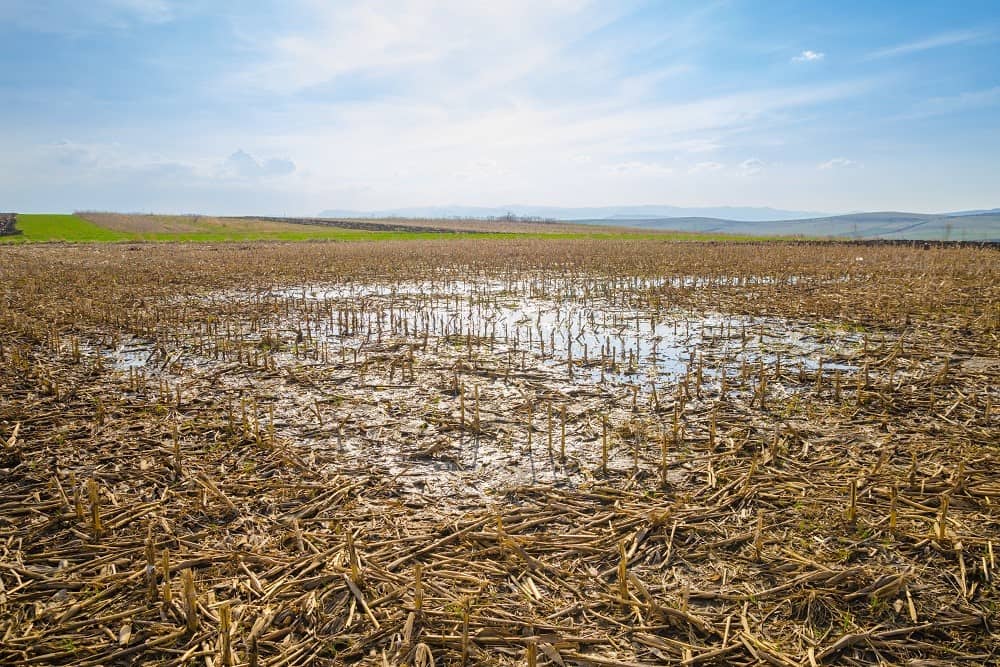
But the same rainfall that improved water supplies has also raised concerns for corn producers dealing with saturated soils and standing water in fields—particularly in poorly drained areas, river bottoms, and low-lying ground.
Agronomists caution that the impact of flooding on corn is highly variable and depends on several factors, including plant growth stage, the depth and duration of standing water, and air and soil temperatures during the event.
Corn younger than the V6 stage—before six fully collared leaves have emerged—is especially vulnerable because its growing point remains near or below the soil surface. If plants are fully submerged, oxygen in the soil can be depleted within roughly 48 hours, leaving seedlings unable to sustain critical functions. Warm temperatures, such as those recently experienced in Indiana, can accelerate damage by increasing plant respiration while reducing oxygen availability in waterlogged soils.
Once floodwaters recede, experts recommend waiting at least three days before assessing plant survival. Growers are advised to split stalks and inspect the growing point: healthy tissue appears white or cream-colored, while dead tissue turns dark and soft.
Even when plants survive, prolonged saturation can damage root systems, limiting nutrient and water uptake. That disruption can have consequences later in the season, including reduced kernel development during pollination or increased stress during grain fill. Some areas of Indiana still have corn in rapid vegetative growth, while others are entering or already in pollination—making timing of stress events particularly consequential for yield outcomes.
Floodwaters can also leave behind mud and debris that coat leaves and accumulate in the whorl, reducing photosynthesis and potentially increasing susceptibility to fungal and bacterial diseases. In more severe cases, where water rises above developing ears, ear rots may develop.
Beyond plant health, excess rainfall can also affect soil fertility. Nitrogen losses may occur through leaching in lighter soils or denitrification in saturated, oxygen-depleted conditions. In those environments, soil microbes convert plant-available nitrogen into gases that escape into the atmosphere, reducing fertilizer efficiency. Whether supplemental nitrogen applications are warranted is often difficult to determine and depends on multiple field-specific factors, including timing, soil type, and fertilizer source.
While flooding is the immediate concern, forecasters are also warning of a different kind of risk as May progresses. Despite recent rainfall, climate outlooks indicate a slight possibility of frost or freeze events next week, particularly in low-lying areas and farther north. That raises additional concerns for emerging vegetation that may still be sensitive to cold snaps.
For now, Indiana sits in a transitional period—recovering from earlier dryness, managing pockets of flood stress, and watching closely for late-season cold threats that could further complicate an already variable start to the growing season.
Sources: Dan Quinn and Beth Hall, Purdue University