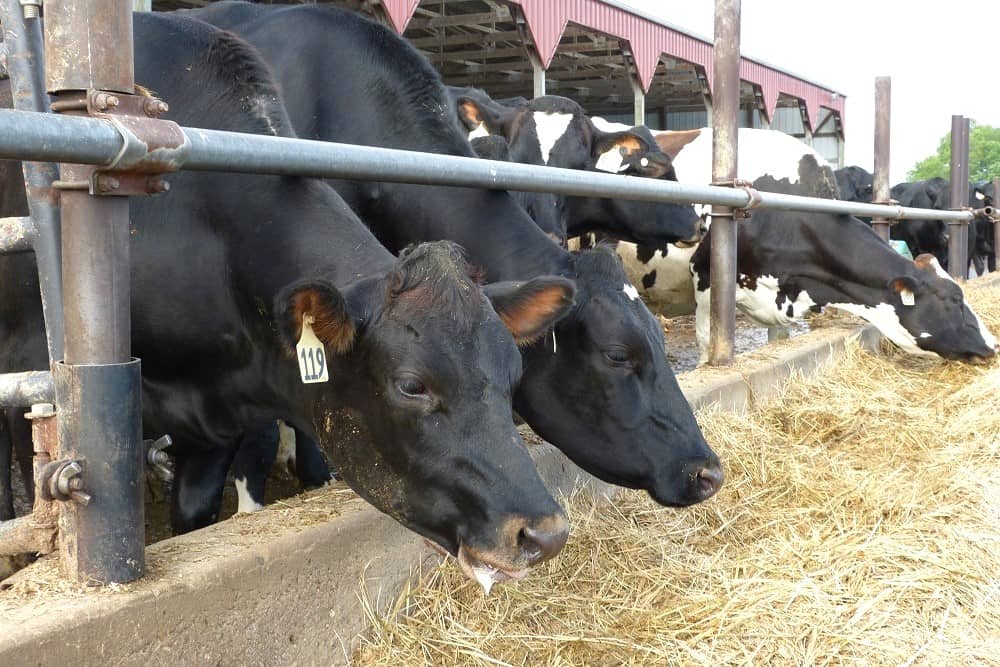
Hoosier dairy producers are on high alert following the confirmation of the H5N1 influenza virus in two operationally connected dairy herds in Newton County in northwestern Indiana. The detection officially strips Indiana of its “unaffected state” status and triggers immediate mandatory movement restrictions, farm quarantines, and a 10-kilometer surveillance buffer zone near the affected farms.
The initial detection did not originate from clinical signs on the farm, but through routine National Milk Testing Strategy (NMTS) bulk-tank surveillance at an out-of-state dairy processing facility. After the virus was flagged in a holding silo receiving Indiana milk, the Indiana State Board of Animal Health (BOAH) collected follow-up samples at the source farms. The tests were confirmed positive by the Indiana Animal Disease Diagnostic Laboratory (ADDL) and verified by the USDA National Veterinary Services Laboratories (NVSL) in Ames, Iowa.
When pressed on where the processing facility is located, BOAH officials declined to identify the specific state of origin, stating that state health officials and veterinarians in that jurisdiction are still actively investigating epidemiological links and contacting partners before details are made public.
For Indiana’s 660 dairy operations—which together produce more than 4.51 billion pounds of milk annually—the regulatory landscape has immediately shifted. Indiana is now the 21st state in the U.S. where a positive case of H5N1 has been detected in dairy cattle.
Mandatory Interstate Testing & Herd Status Options
Under USDA federal orders, any lactating dairy cow or dairy-beef cross leaving Indiana must now test negative for H5N1 prior to interstate movement. Private herd veterinarians must collect individual animal samples for testing through the ADDL or accredited diagnostic facilities before shipment paperwork can be cleared.
To bypass individual animal testing delays and reduce paperwork for high-frequency shippers, BOAH is urging regular interstate exporters to enroll in the USDA Dairy Herd Status Program.
“Under a normal movement, every individual animal needs to be tested before that lactating dairy cow can move across state lines,” explained Denise Derrer Spears, Public Information Officer for BOAH. “If the herd is tested on a weekly basis, that establishes a status for all the animals in that herd, and therefore they can just make the movement as needed.”
Producers interested in enrolling in the voluntary program should contact BOAH at animalhealth@boah.in.gov or work directly with their herd veterinarian.
Quarantine Protocol & The 10-km Surveillance Zone
For the two infected dairies in Newton County, strict quarantine orders are in effect for all lactating cattle. Under BOAH’s emergency response plan, farm-level testing will continue weekly until the herds achieve two consecutive negative bulk-tank tests, at which point the quarantine will be lifted.
The impact extends well beyond the two affected operations. BOAH has established an active 10-kilometer (6.2-mile) Surveillance Zone around the infected sites. All Grade A dairy farms and commercial poultry facilities located within this 10-km perimeter are subject to mandatory community spread verification. Surveillance testing within the zone will be conducted every 28 days until the quarantined farms complete their clearance protocols.
To assist with wildlife vectors, USDA Wildlife Services and the Indiana Department of Natural Resources (DNR) are conducting active wild bird surveillance in and around the Newton County surveillance perimeter. Wild waterfowl were identified as the primary catalyst when H5N1 first crossed into U.S. dairy cattle in Texas back in March 2024.
Biosecurity Focus: Transmission Routes Between Operations
Epidemiological investigations into H5N1 outbreaks across the Midwest—including USDA findings from Michigan’s 2024 dairy event—reveal that disease spread between dairies is rarely driven by live animal additions. Instead, transmission occurs through indirect operational links: shared personnel, contract haulers, deadstock pickup, feed deliveries, and unpasteurized milk transport.
Because the two Newton County herds were described as operationally connected, BOAH is warning neighboring farms and connected operations to audit every daily off-farm traffic point.
“Really, what it gets down to when it comes to biosecurity, the basics are really, really important: clean hands, clean feet, clean vehicles,” Spears emphasized. “Cleaning your hands and feet before you get in and out of a truck, a tractor, or any type of vehicle on and off of those farms is really important, especially before going to the next farm.”
Spears cautioned producers against viewing biosecurity as a seasonal task.
“Biosecurity is really important, and that’s 365 days a year,” Spears said. “You can’t just think, ‘Oh, it’s high-path flu season,’ and just do it now. It can happen to anybody, anytime, and it just really emphasizes—regardless of the species or the type of operation—clean hands, clean feet, clean equipment.”
Because the H5N1 virus is heavily concentrated in raw, unpasteurized milk, BOAH stresses that equipment, tires, and footwear exposed to parlor wash water or raw milk must be thoroughly disinfected before leaving any facility.
Consumer Confidence & Herd Monitoring
State health and agricultural officials reiterate that the discovery presents no food safety threat to the public. Commercial pasteurization effectively inactivates the H5N1 virus, and pasteurized milk, eggs, beef, and poultry remain completely safe for consumers. However, pet owners are advised against feeding uncooked diets or raw milk to household animals, as domestic cats are highly susceptible to severe H5N1 clinical illness.
Producers across Indiana should closely monitor cattle for hallmark symptoms, including:
-
Sudden drop in herd-wide milk production
-
Tacky, thickened, or colostrum-like milk consistency
-
Decreased feed intake and rumen motility
-
Diarrhea, lethargy, dehydration, and fever
If clinical signs appear, cattle owners should isolate affected animals and contact their herd veterinarian immediately.
For real-time updates on Indiana’s H5N1 dashboard, surveillance status, and e-newsletter alerts, visit the Indiana State Board of Animal Health website at in.gov/boah.
CLICK BELOW for Hoosier Ag Today’s radio news story: