
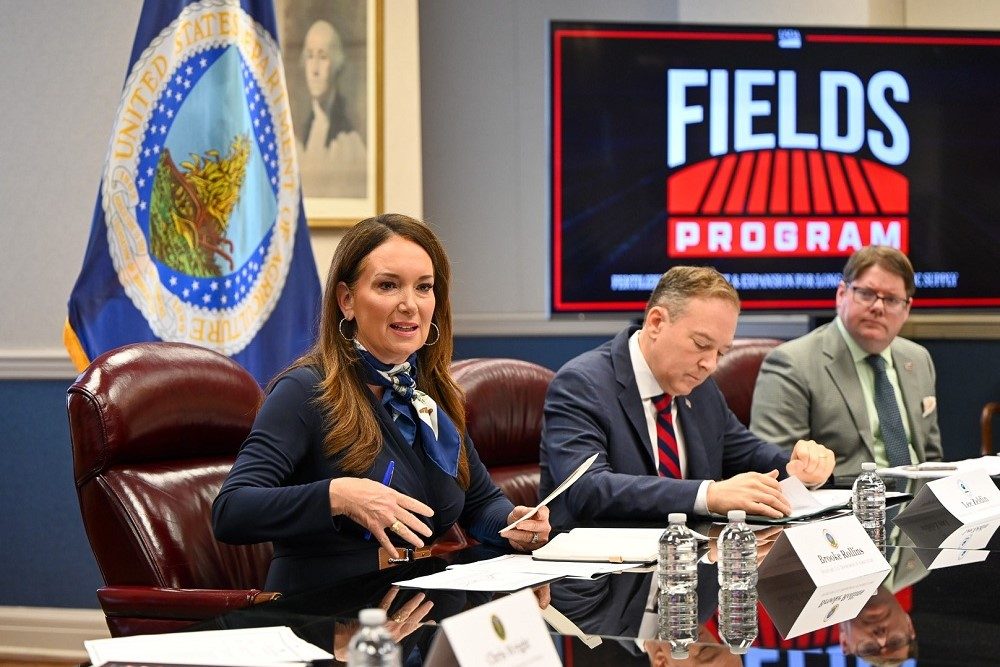
A proposed fertilizer manufacturing project in Fair Oaks, Indiana, is among eight projects selected by the U.S. Department of Agriculture to advance a nationwide effort to strengthen domestic fertilizer production, reduce reliance on foreign suppliers and help address mounting concerns over input costs for American farmers.
The project, led by Agriculture Project Holdco, is part of a combined $1.34 billion investment in fertilizer manufacturing across 16 states. The initiative includes approximately $573 million in proposed USDA funding, including $116.9 million earmarked for the Kansas- and Indiana-based project.
Announced Thursday by Vice President J.D. Vance and Agriculture Secretary Brooke Rollins, the investment is intended to expand U.S. fertilizer manufacturing capacity and improve the long-term availability of critical crop nutrients.
For Indiana agriculture, the Fair Oaks project offers a potential new source of fertilizer production by converting dairy manure into liquid ammonium nitrate fertilizer — linking livestock production with the manufacturing of a key crop input.
Under the proposal, Agriculture Project Holdco would develop two manufacturing facilities, one in Lewis, Kansas, and the other in Fair Oaks. Together, the facilities are expected to produce approximately 4,100 tons of liquid ammonium nitrate fertilizer annually.
The project represents one piece of a broader federal strategy to rebuild domestic fertilizer manufacturing and reduce the vulnerability of American farmers to international supply disruptions and price volatility.
“Farm security is national security. America cannot afford to depend on foreign nations for the fertilizer needed to grow our food and feed our families,” Rollins said in announcing the selections.
Fertilizer independence a growing concern
The USDA investment comes as fertilizer affordability and supply-chain reliability remain major concerns for crop producers. Global disruptions, geopolitical tensions and a concentrated fertilizer manufacturing industry have left farmers exposed to market swings that can significantly affect production costs and profitability.
According to the USDA, four companies control approximately 77% of North America’s nitrogen fertilizer production capacity. Two companies account for more than 90% of phosphate production capacity, while two producers supply approximately 90% of the continent’s potash production.
The administration says expanding domestic manufacturing could help increase competition, diversify supply and give farmers more options when purchasing essential crop nutrients.
USDA economic analysis estimates the eight selected projects could reduce nitrogen fertilizer prices by 4.4% and potash prices by 5.3% once the additional production capacity becomes operational. The projects are also expected to increase domestic nitrogen production by 3.7% and potash production by nearly 40%.
Those estimates reflect the potential nationwide effects of the combined projects, rather than guaranteed price reductions for individual farmers. Actual fertilizer prices will continue to depend on production costs, transportation, demand and conditions in global markets.
The eight projects are expected to support approximately 1.08 million tons of annual domestic fertilizer production and capacity.
Turning dairy manure into fertilizer
The Fair Oaks project stands out for its proposed use of dairy manure as a feedstock for fertilizer manufacturing.
By converting manure into liquid ammonium nitrate, the facilities would add domestic fertilizer production capacity while creating another potential pathway for putting livestock-derived materials to agricultural use.
Ammonium nitrate is a nitrogen fertilizer, making the proposed project particularly relevant to crop producers seeking dependable access to nitrogen, one of the essential nutrients needed to support crop growth and yield potential.
The USDA announcement, however, does not identify a construction schedule, specific production start date or projected local employment figures for the Fair Oaks facility. Those details will help determine when Indiana farmers and the surrounding agricultural economy could begin to see the project’s benefits.
The $116.9 million in proposed USDA funding is part of a larger $360 million investment covering both the Kansas and Indiana facilities.
Eight projects selected nationwide
The Fair Oaks project is one of eight selected through USDA’s Fertilizer Investment & Expansion for Long-Term Domestic Supply, or FIELDS, Program.
The program was launched July 1 with $500 million intended to expand American fertilizer manufacturing. The administration is also redirecting funding recovered from projects associated with the previous administration’s Fertilizer Production Expansion Program.
USDA officials say the FIELDS initiative prioritizes projects with stronger financial viability, private-sector investment, demonstrated market demand and a clearer path to implementation.
In addition to Agriculture Project Holdco, the selected projects include a proposed sulfate of potash facility near Carlsbad, New Mexico; ammonia manufacturing expansion in Virginia; fertilizer plant modernization in Texas and Oregon; and projects involving nitrogen, phosphorus, potassium and sulfur fertilizer production in several other states.
Collectively, the projects are intended to expand the range of fertilizer products manufactured domestically and reduce dependence on imported supplies.
The USDA says the selections mark an important step toward strengthening the nation’s fertilizer supply chain, although the proposed investments must still advance through the funding and implementation process before the anticipated production and market effects can be realized.
For Indiana farmers, the Fair Oaks project puts the state among the locations targeted for a new generation of domestic fertilizer manufacturing. Whether that investment ultimately translates into more accessible fertilizer and meaningful cost relief will depend on the project’s execution and the broader market conditions producers face in the years ahead.