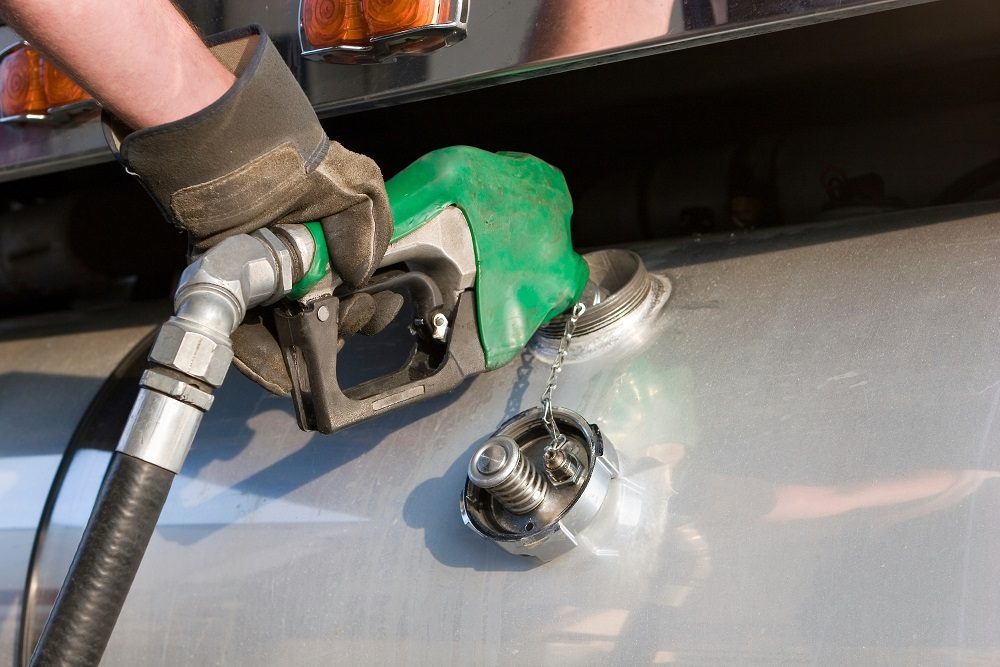
Combine cabs across Indiana are humming, but the financial strain sitting in the fuel tank has hit an all-time breaking point. As autumn harvest hits full throttle across the Corn Belt, Hoosier producers hauling grain to elevators and processors are confronting diesel prices hovering near $7 a gallon—as the state average reached an all-time record high of $6.92 a gallon on Sept. 24.
In an immediate response to mounting economic pressure on the agricultural sector, Indiana Governor Mike Braun renewed the state’s energy emergency declaration on Wednesday. The action extends the suspension of both the state Gasoline Use Tax and Gasoline Excise Tax through November 4.
More importantly for grain, livestock, and ag haulers, Braun’s executive order lifts special fuel restrictions to allow farmers to use untaxed, red-dyed off-road diesel for any farm-related activities, including semi-truck road hauling. The dyed, off-road diesel in Indiana is averaging 85 cents cheaper per gallon than on-road diesel.
“Affordability is my top priority, and my gas tax suspensions have delivered immediate tax relief and some of the cheapest gas in America for Hoosier families,” Governor Braun stated. “I’m delivering relief for Hoosier farmers by lifting special fuel restrictions to help ease the burden, and providing relief from high gas prices to keep more money in Hoosiers’ pockets and make life more affordable.”
The executive action delivers a direct victory for farm advocacy groups who have sounded the alarm on input inflation throughout the 2026 growing season.
“Indiana Farm Bureau applauds Governor Braun’s decision to include dyed diesel in the state’s gas tax exemption,” Indiana Farm Bureau noted in a statement released following the announcement. “As harvest season is underway here in Indiana, this will provide relief to farmers who rely on it to operate essential off-road equipment to provide food, fuel and fiber for the world. We appreciate the governor’s support for Indiana agriculture and for listening to our concerns about the ongoing economic pressures farmers are facing from high input costs.”
According to the governor’s office, the emergency declaration stems from severe global supply chain disruptions, including Houthi drone strikes targeting Saudi Arabia’s East-West Pipeline—which controls 7% of global oil shipments—and ongoing military tensions in the Red Sea alongside reduced refining capacity in Eastern Europe.
The State Line Risk
While Hoosier growers welcomed the state relief, agricultural leaders caution that a state-level waiver is only half the battle when grain trucks hit the highway.
State Representative Beau Baird (R-Greencastle) spearheaded a movement calling for both state and federal action, authoring letters to Governor Braun and President Donald Trump. Baird warns that while an Indiana farmer can legally pour dyed diesel into a road tractor under Braun’s order inside state lines, crossing into neighboring states like Illinois, Kentucky, Ohio, or Michigan exposes haulers to massive federal IRS fines—which start at $1,000 per violation—if federal agencies don’t mirror the waiver.
Baird points out that grain marketing doesn’t stop at political boundaries. Indiana producers along state borders routinely haul corn and soybeans across state lines to major river terminals, crush plants, and ethanol facilities.
“I think it’s important that we look at this from a state and a federal perspective,” Baird explained. “The reason I say that is I’m really concerned about the farmers along the border of Indiana. If Indiana [farmers take] their commodity across the line into Illinois, Ohio, Michigan, Kentucky who hasn’t done something like what we’re trying to do, how do they stay compliant?”

Protecting the Full Ag Supply Chain
Baird’s request to federal officials seeks a temporary 45-day nationwide waiver of dyed-diesel penalties for agricultural transport. He emphasizes that relief must not be limited strictly to grain transport, but must safeguard the entire agricultural logistics web—including livestock, poultry, and timber operations that utilize heavy diesel equipment daily.
“Our hardwood industry is one of the biggest sectors of the agricultural community. Those pieces of equipment are in the woods and they’re using off-road diesel, and so my hope is that maybe they could be included as well,” Baird said. “Those producers are also part of that same supply chain and equally important, and I hope that we can find relief for all of them.”
As combines roll uninterrupted through November 4, Indiana producers now have temporary relief at home. However, all eyes remain on federal regulators to see if national enforcement waivers will follow to protect state-line grain movement through the peak of harvest.