
For Indiana farmers and livestock producers still cleaning up after August’s devastating storms and flooding, the federal disaster designation has moved recovery into its next phase.
Now, USDA’s Farm Service Agency is telling producers: don’t wait to report your losses.
A Presidential disaster declaration covering 21 primary Indiana counties and 25 contiguous counties allows FSA to make emergency disaster loans available to eligible producers suffering production and physical losses from severe storms, straight-line winds, tornadoes and flooding.
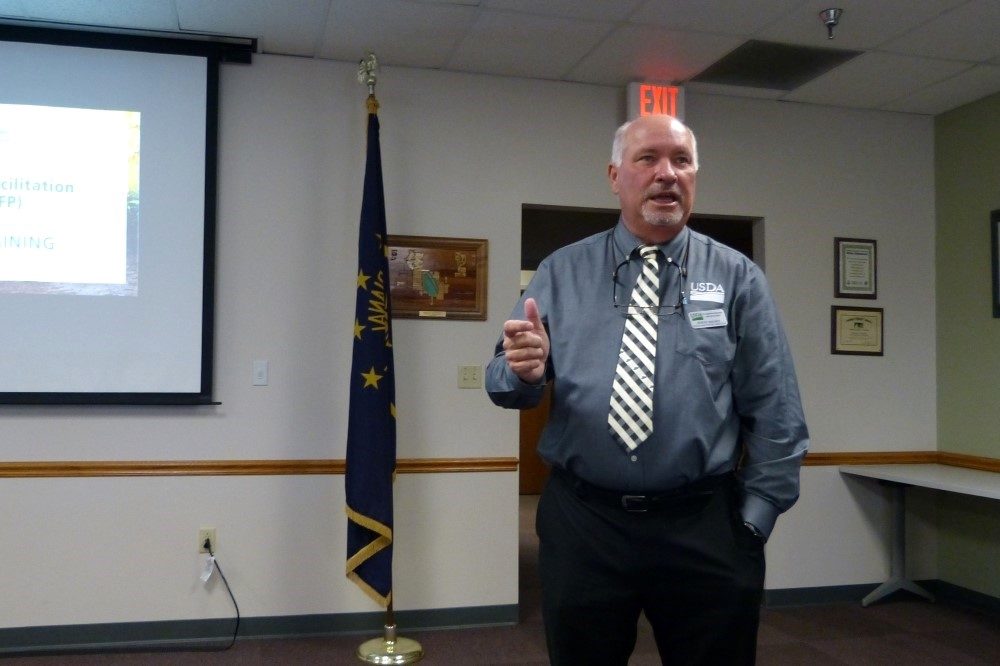
For farmers who have been waiting to see what federal assistance might become available, Indiana FSA State Executive Director Steve Brown said the first step is straightforward.
“So, the first thing producers need to do is if they’ve got damage, they need to come and report the damage and loss to their local county office,” said Brown.
The declaration is significant because it activates FSA’s emergency loan authority for producers in the designated areas. Those loans can provide low-interest financing to help replace essential property, equipment or livestock, recover from production losses, reorganize an operation or refinance certain farm-related debts.
“Right now, the designation makes uh makes producers eligible for our uh emergency disaster assistant loan program. That that will assist them with low interest loans to to recover any losses or any things that they may have to to get replaced,” said Brown.
But emergency loans are only one piece of the disaster-assistance puzzle.
Livestock producers who lost animals during the flooding may be eligible for the Livestock Indemnity Program, or LIP. USDA says the program can provide payments for livestock deaths above normal mortality or livestock sold at a reduced price because of an eligible adverse weather event.
Brown says Indiana producers have already reported livestock losses associated with the storms and flooding.
“It also we’ve had programs from the Working Families Tax Cut Bill that was signed over a year ago. It enacted some of the programs that were made available by that act, and that’s the livestock indemnity program, and that’s for producers that may have lost livestock in these heavy rains and flooding,” according to Brown.
The Emergency Assistance for Livestock, Honeybees, and Farm-Raised Fish Program, or ELAP, may also provide assistance for eligible feed and grazing losses. USDA says ELAP can cover certain honeybee colony, hive and feed losses as well.
For producers, however, qualifying for assistance begins with documenting what happened.
FSA is urging farmers and livestock producers to preserve photographs and videos of damage, along with farm records, herd inventories, receipts, sales records and other documentation that can establish the extent of losses.
Brown says producers should not wait until every loss is calculated before making contact with FSA.
“The quicker [those affected] get in, the quicker we can get the process started,” Brown said.
That advice is especially important for producers dealing with multiple USDA programs.
Farmers with federal crop insurance should report damage to their crop insurance agent within 72 hours of discovering the damage and follow up in writing within 15 days. Producers with Noninsured Crop Disaster Assistance Program coverage generally must file a Notice of Loss with FSA within 15 days of the loss becoming apparent, with a shorter 72-hour requirement for hand-harvested crops.
Those deadlines are separate from the April 26, 2027, deadline for emergency disaster loan applications.
Other programs also have their own deadlines. For example, USDA says notices of loss and applications for the 2026 Livestock Indemnity Program and ELAP generally must be submitted by March 1, 2027.
That makes early contact with FSA particularly important.
The 21 primary Indiana counties covered by the disaster designation are Carroll, Dearborn, Decatur, Delaware, Fayette, Franklin, Hamilton, Hancock, Henry, Lake, LaPorte, Madison, Marion, Morgan, Porter, Pulaski, Randolph, Rush, Tipton, Union and Wayne.
Farmers in the following designated contiguous counties may also qualify for assistance: Bartholomew, Blackford, Boone, Brown, Cass, Clinton, Fulton, Grant, Hendricks, Howard, Jasper, Jay, Jennings, Johnson, Marshall, Monroe, Newton, Ohio, Putnam, Ripley, St. Joseph, Shelby, Starke, Tippecanoe, and White.
The federal response can extend beyond crop and livestock losses. FSA’s Emergency Conservation Program can assist with restoring damaged farmland and conservation structures, while USDA’s Natural Resources Conservation Service can provide technical assistance and help producers evaluate conservation needs following the disaster.
For producers, the message from FSA is clear: document the damage, report the loss and start the conversation with USDA now.
The full extent of the August storms’ impact may not be known for some time, but waiting for a final damage assessment could cost producers valuable time as they work to navigate the assistance programs now available.
CLICK BELOW for Hoosier Ag Today’s radio news report: