The Trump administration rolled out a sweeping interagency partnership Thursday designed to shield the nation’s farmers and ranchers from what it calls “environmental lawfare”—a coordinated effort, officials say, by federal bureaucrats, activist groups, and well-funded environmental nonprofits to tie up agricultural operations in costly legal battles and regulatory red tape.
U.S. Secretary of Agriculture Brooke Rollins announced the signing of a new Memorandum of Understanding (MOU) with the Small Business Administration (SBA). The agreement formalizes a joint pipeline between the newly minted USDA Lawfare Portal and the SBA’s Office of the National Ombudsman, giving independent producers a federal beachhead to report aggressive regulatory actions and seek immediate interagency intervention.
The initiative advances a central pillar of the administration’s “Farmer and Rancher Freedom Framework,” which treats federal enforcement disputes not merely as routine administrative oversight, but as an existential threat to generational American businesses.
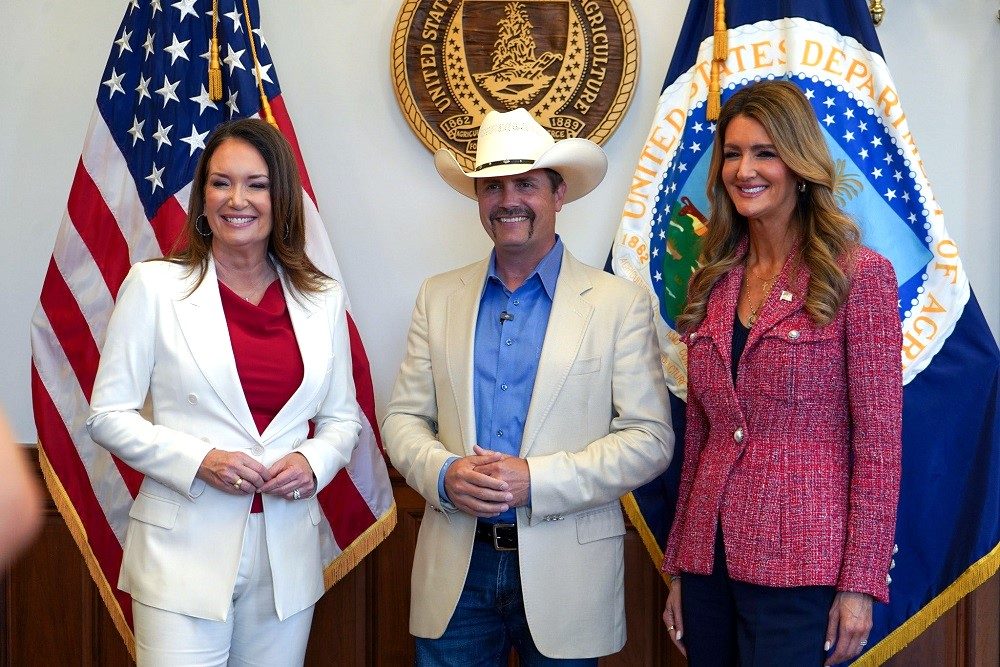
“Producers and ranchers who feed this nation should never face the full power of government alone,” Rollins said at an afternoon press conference, standing alongside SBA Administrator Kelly Loeffler, lawmakers, and affected producers. “Through the USDA Lawfare Portal and interagency collaboration, we are delivering real protection.”
A Legal ‘Shield’ for Small Producers
For agricultural advocates, the announcement targets a long-standing structural imbalance in rural America. While industrial-scale agribusinesses employ internal legal teams to navigate labyrinthine environmental compliance, independent ranchers and mid-sized farmers frequently lack the capital to combat multi-year federal enforcement actions or environmental litigation.
The partnership explicitly routes agriculture-related complaints filed via the USDA portal through the SBA’s investigative apparatus. Under the new workflow, the two agencies will jointly investigate compliance disputes stemming from actions taken by other heavyweights of federal land management and environmental enforcement, including the Environmental Protection Agency (EPA), the Department of the Interior (DOI), and the Bureau of Land Management (BLM).
The administration intends to use data harvested from the portal to identify systemic regulatory overreach and drive targeted, cross-agency deregulation.
“Farmers and ranchers do some of the hardest and most essential work in America, yet they have faced a growing burden from costly federal regulations,” Loeffler said, noting that the infrastructure will provide small operations a direct line to fight back against rules that threaten to crush generational estates.
The press conference also served to amplify the role of country music star John Rich, who was recently appointed by President Trump as Special Envoy for American Landowners at the USDA. Rich, who has traveled extensively meeting with property owners, framed the issue as an economic drain on rural communities. “For too many ranching families, lawfare has become just another cost of doing business,” Rich said. “This partnership sends a clear message: the federal government is done standing on the sidelines.”
Tangible Relief for the Field
While Washington policy announcements can often feel abstract to rural operators, the administration paired the policy rollout with a list of localized “wins” and specific case studies detailing exactly how this shield is expected to operate on the ground:
-
Restoring Public Land Access: In Arizona, multigenerational ranchers Becki and Dustin Ross have seen their operations hamstrung by U.S. Forest Service (USFS) delays, including multi-year backlogs on archaeological clearances required just to clean out stock tanks. The USDA’s direct intervention on grazing access is tailored to bypass these administrative hurdles, fast-tracking maintenance and allowing producers to rebuild drought-impacted herds.
-
Halting Costly Litigation Cycles: In Montana, family farms like those operated by Dalton and Madison Pauley have faced cascading lawsuits from environmental groups claiming irrigation practices threaten bull trout populations—even when federal surveys found no trout in the local diversions. Because federal statutes often reimburse nonprofit attorney fees, independent ranchers face financially ruinous cycles of defense costs. The new framework positions the USDA as an institutional ally to mitigate these targeted legal pressures.
-
Pushing Back Against Green Energy Displacement: The framework also signals a sharper federal stance against projects that convert prime agricultural acreage into green energy infrastructure. In Arizona, cattle ranchers Casey and Meggan Murph are fighting a proposed solar project by a foreign developer on state-leased grazing land, while in New York, local growers are pushing back against state-level fast-tracking of industrial wind and solar installations that bypass local zoning boards. The USDA recently halted federal taxpayer subsidies for solar panels on productive farmland, a policy alignment that ranchers say protects the long-term integrity of domestic food supplies.
A Rapidly Accelerating Deregulatory Agenda
The newly forged alliance arrives amid an aggressive deregulatory push by the department. In the last fiscal year, the USDA executed 73 distinct deregulatory actions, achieving an estimated $136 million in cost savings for producers.
Among its recent administrative actions, the USDA has systematically rolled back Biden-era guidance documents, re-established centralized rule registries to increase transparency, and finalized a rule via the Risk Management Agency ensuring that adverse agency determinations apply strictly to the requesting party, prevents those interpretations from being weaponized broadly against neighboring farms.
The administration also finalized a rule removing race- and sex-based “socially disadvantaged” criteria across the USDA’s portfolio of loans, grants, and conservation programs, transitioning instead to an model based strictly on operational and geographic necessity.
For representatives from the conservative and libertarian legal organizations present at the signing—including the America First Policy Institute, the Institute for Justice, and the Pacific Legal Foundation—the MOU represents a profound shift in how Washington interacts with rural landowners. Rather than acting as an antagonist, the federal government is positioning itself as a defense counsel of last resort for the people who work the land.
Producers facing regulatory actions or litigation are being directed to report their cases directly through the agency’s dedicated portal at www.usda.gov/lawfare.

