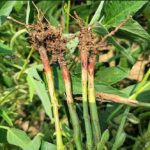
An emerging soybean disease in the Midwest is requiring growers to be more vigilant when scouting.
“Red Crown Rot is here,” says Purdue crop pathologist Dr. Darcy Telenko on the latest Purdue Crop Chat.
Unfortunately, there’s nothing that can be done about red crown rot for your soybeans this year. A seed treatment would have been the deterrent, but it’s still important to scout and know if it’s in your field. Telenko explains that’s easier said than done.
“The problem is it mimics three other diseases. It has the same foliar symptomology as our Sudden Death Syndrome, SDS. It could also mimic Brown Stem Rot. So, it’s important when that time frame comes, end of July to early August, and you start seeing those little areas that are turning yellow, your crop is not maturing, there’s something going on. Get out and look at it. Maybe you diagnosed SDS 10 years ago and it came back today but go out and, that’s my big push, go out and check them, make sure it hasn’t changed to something else.”
If you suspect red crown rot, a sample can be sent to Purdue for confirmation. The cost for that sample is covered by the Indiana Soybean Alliance. Information on how to do that can be found at indianafieldcroppathology.com.
Once red crown rot is confirmed, Telenko says you will want to harvest that field last to reduce the spread of the fungus to a new field.
“We do have some research going on to try to see what the combines are moving and where is the pathogen surviving. Is it in the soil? Is it in the stubble? Is it in the debris? Are we blowing it out of the back of the combine in the dust? We’ve been running some pretty interesting trials this last year. I followed some fields, so we’ll be looking for that again.”
Learn more about red crown rot from Telenko and ‘Soybean Shaun’ Casteel in the Purdue Crop Chat. Watch below or on our Facebook page and listen wherever you find your favorite podcasts!

