
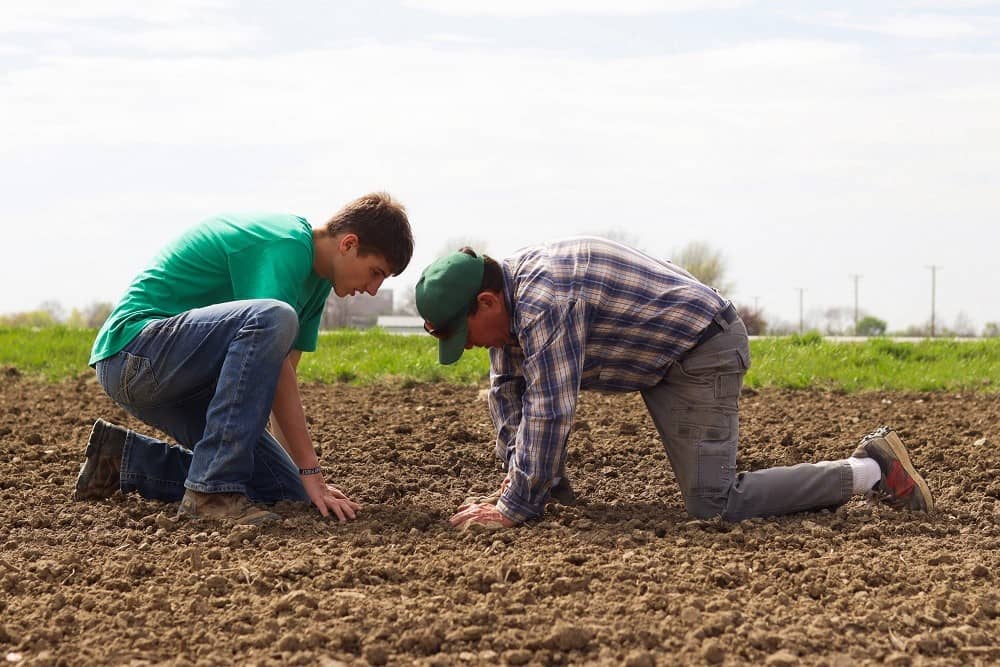
As Indiana farmers watch the calendar push deeper into May, a familiar anxiety is setting in: whether a delayed planting season will force difficult compromises on corn yield.
Unpredictable spring weather has long complicated planting decisions across the Midwest, and in years when fieldwork stretches into late May or even early June, growers often face a pressing question — stick with full-season corn hybrids or pivot to shorter-season varieties. The instinct to switch can feel prudent, but agronomists say it is not always necessary.
“The decision gets framed as more urgent than it really is,” said Dan Quinn, Extension corn specialist with Purdue University. “If you understand how the crop actually develops, you can make a more measured choice and avoid sacrificing yield potential unnecessarily.”
At the heart of that decision is a concept often misunderstood outside agronomy circles: corn maturity is not determined by calendar days, despite the familiar labeling of hybrids as “113-day” or “110-day” corn. Instead, development hinges on the accumulation of heat, measured in growing degree days, or GDDs.
Each hybrid requires a specific number of these thermal units to reach physiological maturity — the point at which kernels form a “black layer” and cease development. Seed companies publish GDD requirements, and farmers increasingly rely on digital tools to estimate whether a given hybrid will mature before the first killing frost.
Among those tools is the U2U Corn GDD decision support model developed by the Midwest Regional Climate Center, which allows users to project silking and maturity dates based on planting timing, hybrid selection and location. It also incorporates historical frost data, offering a risk assessment that can guide late-season decisions.
But such tools have limitations. Notably, they often do not account for a phenomenon that researchers say plays a critical role in late-planted corn: growing degree day compression.
“Hybrids don’t need the same number of heat units when they’re planted later,” Quinn said. “As planting is delayed, the crop tends to accumulate GDDs more efficiently, effectively shortening the time needed to reach maturity.”
Research from Indiana and more recent studies in Michigan suggest that after May 1, corn hybrids may require roughly 6.4 to 6.8 fewer GDDs for each day planting is delayed. The implications are significant. A hybrid that might typically need about 2,800 GDDs when planted in early May could require closer to 2,600 GDDs if planted near the end of the month — a reduction that can accelerate maturity by days or even weeks.
That shift can make the difference between a crop reaching maturity safely before a fall frost and one at risk of damage. It also challenges a long-standing assumption that late planting automatically necessitates shorter-season hybrids.
In practical terms, Quinn said, many producers may be switching hybrids too soon. “There’s a tendency to move away from full-season hybrids earlier than needed,” he said. “But when you factor in GDD compression, those fuller-season hybrids often remain viable later into the planting window than people expect.”
The trade-off is not trivial. Shorter-season hybrids typically carry lower yield potential, meaning that an unnecessary switch could cost farmers bushels at harvest. At the same time, waiting too long to adjust carries its own risks if an early frost cuts the season short.
The challenge, then, is calibration — balancing yield potential against weather risk with as much precision as possible.
Agronomists recommend pairing GDD-based insights with localized frost projections and decision tools to fine-tune hybrid selection. The goal is not to eliminate uncertainty, but to manage it more effectively.
For Indiana growers navigating another unpredictable spring, the message is less about urgency than understanding. Delayed planting does not automatically demand a drastic change in strategy. In many cases, sticking with a fuller-season hybrid — longer than instinct might suggest — could be the more profitable path.
“Ultimately, it’s about making informed decisions instead of reactive ones,” Quinn said. “When you understand how the crop responds to later planting, you can preserve yield potential without taking on unnecessary risk.”