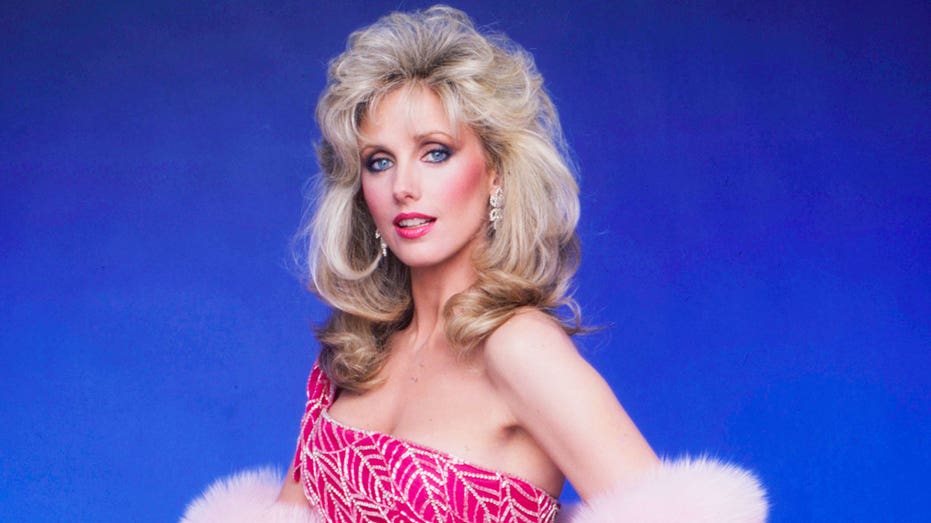
Morgan Fairchild may have made audiences wonder if she was “too sexy for TV,” but she refused to play Hollywood’s so-called game to get ahead.
The actress, whose breakout role in the soap “Flamingo Road” cemented her bombshell image before she became a glamorous vixen on “Falcon Crest,” has a new podcast, “2 B—-es From Texas,” co-hosted with her sister, Cathryn Hartt. The show features never-before-heard stories from their decades in showbiz and sit-down interviews with celebrity friends.
The 76-year-old told Fox News Digital that, looking back, she didn’t want “to sell my soul” to get ahead.
DYAN CANNON TRIED ‘DRUGS, MEN AND PILLS’ BEFORE BECOMING A ‘GOD GIRL’
“When I first moved to L.A., everyone told me, ‘If you don’t go to the right parties, if you don’t sleep with the right people, and if you don’t do what everybody does, you’re never going to get anywhere,’” she said. “Well, I don’t even drink, much less do drugs. I just never did. When they told me that’s what it takes to make it here, I thought, ‘Then I guess I just won’t have a career.’”
“I know there are jobs I lost because I wouldn’t sleep with people,” Fairchild reflected. “I know that, and I accept that I wasn’t willing to accept that. I just wasn’t willing to sleep with them.”
Before becoming an ’80s icon, Fairchild got her first taste of Hollywood with a small, uncredited role in 1967’s “Bonnie and Clyde,” starring Warren Beatty and Faye Dunaway.
WATCH: HOLLYWOOD LEGEND LORENZO LAMAS ENDORSES REPUBLICAN FOR CALIFORNIA GOVERNOR
“I went to a cast party, and I realized everybody was a little strange,” she said. “The next day, I was walking with one of my mentors, and he said, ‘You seem a little down.’ I told him, ‘I really like working on this movie, but I’m realizing it’s a strange world. I walked out on this party, but that’s the reality of the business, and I can’t just keep walking out on reality.’”
“He gave me the best piece of advice I ever got,” Fairchild shared. “He said, ‘Nonsense, you can always walk out on reality.’ So that’s how I approached Hollywood.
“I create my own reality. I live my own life the way I want to. Those are the choices, as long as you can accept the downside, which is that if you don’t do these things people tell you that you have to do, you may not work. As long as you’re willing to accept that, then you’re fine.”
Fairchild said she never regretted doing things her own way when it came to focusing on her acting career.
“I never had to look back on anything,” she said. “I made my decision early on that I was not going to sell my soul or my pride or my dignity to succeed in this business. I might’ve done a little better if I had, but I was willing to live with that.”
Like on her podcast, Fairchild enjoys revisiting her past — even the times she unexpectedly found herself in hot water.
CLICK HERE TO SIGN UP FOR THE ENTERTAINMENT NEWSLETTER
Fairchild said People magazine photographed her in early 1981 for a feature on her role in “Flamingo Road.” The issue’s release was postponed after the attempted assassination of President Ronald Reagan that March.
“It was right at the end of our first season, and we didn’t know yet if we were going to get picked up for a second season,” she said.
“That left People magazine with no hook for the cover. And then, Jerry Falwell, founder of the Moral Majority, and Rev. Donald Wildmon declared me ‘too sexy for TV.’ They tried to censor me and get me kicked off TV.”
“They handed me the cover back,” Fairchild said with a laugh. “They gave People the hook, and it got a lot more coverage than it would have otherwise.”
Falwell and Wildmon publicly denounced what they viewed as indecent and immoral television, targeting prime-time shows they said glorified promiscuity. Fairchild’s sensual “Flamingo Road” character soon became a high-profile symbol of the content they condemned.
The backlash didn’t hurt Fairchild’s career. Instead, it helped launch her into stardom. People magazine’s July 1981 cover story ran with the headline, “Is she too sexy for TV?” She later earned a Golden Globe nomination.
LIKE WHAT YOU’RE READING? CLICK HERE FOR MORE ENTERTAINMENT NEWS
Fairchild admitted she still has “no clue” why she was targeted at the time.
“I don’t know why they picked me instead of another blonde or someone else on the show,” she said.
“I have no clue why they didn’t like me, but I’m grateful. It gave me the cover back — and it’s not a bad title to have. Otherwise, I’d have just been Morgan Fairchild from ‘Flamingo Road.’ But when they tried to censor me, it backfired. They made me a bigger deal and gave me what’s now considered a classic magazine cover.”
When asked how she felt about being labeled a sex symbol, Fairchild replied, “There are a lot of worse things to be called than a sex symbol.”
“But it still surprises me,” she said. “I wasn’t expecting it, but there are far worse things to be labeled.”
In the 1980s, Fairchild became one of Hollywood’s earliest and most visible advocates during the AIDS crisis. She said it was her choice to speak out when many others stayed silent out of fear of being blacklisted in Hollywood. It was a decision that nearly cost her career.
“I know it cost me work,” she said. “I’ve been told it cost me work by people who were in casting rooms. I’ve been told I was too controversial because of my stance on AIDS. People didn’t want me around their kids. People didn’t want me to eat at their place. They didn’t want me in their homes. But I lost friends. I couldn’t sit back and stay silent.”
“But here was the sweet thing,” she said. “The first time I visited a hospice, I asked myself, ‘What do I say to these guys who are dying? What can I say that’s comforting?’
“I walked in, and three guys came over and said, ‘We want your eye makeup tricks.’ I did it to cheer them up — and I know I lost work because of that. But those are the choices you make. You decide what matters more: playing it safe or trying to help. And I’ll always try to help.”
And she would do it again, Fairchild insisted.
“I’m grateful for where my life choices have taken me,” she added.